

![13th Aug: Barbecue: Smoke Out (2026), 2 Seasons [TV-14] – New Episodes (6/10)](https://occ-0-953-1001.1.nflxso.net/dnm/api/v6/0Qzqdxw-HG1AiOKLWWPsFOUDA2E/AAAABbwuPvycIri4aqfkzVnZZkxxQ18cRR4JrXlIPNphMBjzWFD-K6_-6axovrq7W96Yy8LrGdhCp87alRH13BIRudojKiNa1MGpzcdZ2u3itVtC87jYx_pEm0jcTXNSqy8ZDZXtsH1Wmpmuz8PkzrAL2xqUQb2zBfvmSnOe0RyU.jpg?r=e7d "13th Aug: Barbecue: Smoke Out (2026), 2 Seasons [TV-14] – New Episodes (6/10)")



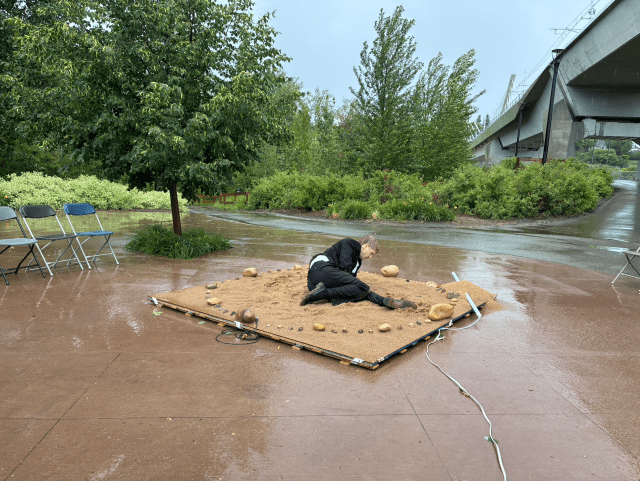
Geoffrey Simon Brown in “untitled (clock piece” at Found Festival 2026, Common Ground
Arts. Photo by Mac Brock
By Liz Nicholls, .ca
I put on my water wings just in case, and found myself this weekend at Found, a plucky and ingenious summer festival of art in unexpected places. In its 15 summers in Edmonton they’ve proven themselves to be water-resistant, true. But this weekend was some sort of ultimate test of resilience. C’mon, is an outdoor performance in a park in the summer too big an ask from the cosmos?

To help support .ca YEG theatre coverage, click here.
Anyhow, first, I salute the awe-inspiring chutzpah of the Freewill Shakespeare Festival, which kept going through wind and rain (even though they weren’t doing The Tempest or King Lear). They were doing the big-cast Broadway musical comedy Something Rotten!. The title is borrowed from Hamlet, not from Environment Canada’s Edmonton office, but hey….
Anyhow, my first stop of Saturday morning, untitled (clock piece), happened al fresco under a sunny sky in Henrietta Muir Park. It is about time. Literally. In the durational performance piece by Toronto’s Susannah Haight and Edmonton’s Tia Kushniruk. six dancers move, in real-time minutes and hours, through a clock configured in stones — for 12 hours. I felt lucky to find it under a sunny sky, just before 11 o’clock when Marina Fekecz-Mangan was approaching the end of her hour, and Emilia Fox Hillyer was preparing to enter the clock. The creators were on hand, and explained that the piece, which is mesmerizing in its own way, has been done elsewhere (Toronto’s Nuit Blanche), but never before in daylight. So the dancers become a slow-mo human sun dial.
Untitled (clock piece) takes on the vibe of the moment. Time, after all, can creep in this petty pace, as a usurping king put it. Or it can fly by. The pandemic seemed to flatten time so that it wouldn’t pass. I had an espresso from the coffee cart stationed there, found a chair, and thought about things like that for a while.
Apparently, the deluge of Saturday afternoon when the heavens (or whatever) opened AGAIN, did not stop the clock for more than a minute or two. Mainly this was because the actor/playwright Geoffrey Simon Brown, whose time on the clock was 2 to 3, wanted to keep going. Amazing. Mac Brock, executive producer of Common Ground Arts, the Found Fest producer who’s by now an expert in the use of wet-vacs, is awestruck by this defiance of the elements. Check out the photo he took.

Sophie May Healey in Hysteria’s House, Found Festival 2026, Common Ground Arts. Photo supplied
In the afternoon, post-deluge, I found myself again at Found in the historic John Walter House in the river valley. In a Victorian parlour, in the company of a half-faced ghost, who emerges from her shroud with a come-hither smile. In Hysteria’s House, created by and starring the gifted clown Sophie May Healey, we’re guests of the possibly deceased Hysteria Winthrop. Hysteria, who hasn’t had company for a while, was delighted to see us: along with her constant companion Cecily she’s been trapped in a house whose previous occupants met grisly fates. As her late father advised her, the only two ways for a classy Victorian girl to get out of the attic are marriage and death. She’s tried the former, and wants to try again, as a genial front-row volunteer named David finds out.
The show is a sly, playfully interactive satire full of amusing anachronisms that point to contemporary parallels. Do we live in a neo-Victorian age? There are unmistakeable signs (as in Hallmark romances, and the corseting and idealization of women; discuss amongst yourselves).
The audience interactions, gracefully managed by Healey in the Oubliette production directed by Alexandra Dawkins, explore Romantic morbidity. Healey makes it fun to join in, as the lighting (by Autumn Strom) flickers and there are ghosts of ghosts.

Pax Anderson and Aidan Laudersmith in SKNHEAD by Shyanne Duquette, Found Festival 2026. Photo by Sable Boltz
On Sunday I found myself at Found again, in the downtown basement of a derelict brick building on 97th St. that none of us — except maybe the festival team led by Whittyn Jason — knew existed. It’s the quintessential dusty basement (and they’d had air purifiers running all last week). But Friday’s storm filled it with a foot of water. Bailing turned out to be part of a Found Fest stage manager’s gig (kudos to Steven Sobolewski).
By Sunday afternoon, the found space scouted by Found was once again atmospheric and perfect for the garage where SKNHEAD, a gut punch of a big, ambitious, richly detailed new play by Cree playwright Shyanne Duquette, happened. And it got a deluxe workshop production directed by Tara Beagan at Found, a send-off into its future life across the country.
SKNHEAD takes us into the urban world of 14-year-old Indigenous and BIPOC boys, tough, hard-ass, poverty-stricken latchkey kids, some left to fend for themselves by working parents, others escaping or avoiding abuse as best they can. Theirs is a world shot through with horrifying violence and layers of endemic, multi-dimensional racism. And Duquette’s play sets about capturing that complex texture, and a gradual but inevitable drift toward tragedy.
By default, Michael (Pax Anderson) and his kid sister (Emily Berard) struggle to parent each other, up against it in every way. For one thing Michael is mixed-race, and being not quite Indigenous and not-quite white is an unstable, complicated terrain in itself.
Can a small but “real” family, and a friend Bishop (Moses Kouyate), counter the lure of a “chosen” family, a gang with a ruthless white boss (Tom Tunski) who decides who’s “in,” and what the entry price will be? Michael’s volatile pal Fitz (Aidan Laudersmith), a veritable time bomb of a kid, has already joined. Cash is an entry-level drug.
Duquette’s vivid, believable dialogue crackles, and it’s made to overlap and cross-hatch with scary speed and physicality by director Beagan. The cast literally hurl themselves into the play. Video projections by designer Andy Moro (a barrage of pop culture images counterpoints close-ups) play across the garage walls, a sensory assault that’s part of the characters’ lives.
I found that in the two-and-a-half hours of this Found workshop outing there’s some repetition, scenes that might be compressed, along with a re-working of the climactic scenes, which do reinforce the idea of an unending cycle, a contagion. But this is a powerful play with a future. We await its next incarnation.