





When Ramon Pelayo moved to Canada from Mexico about eight years ago, he had no idea he’d end up cutting hair a short walk away from a World Cup venue.
Now the owner of La Familia Mexican Barber in Vancouver is among the soaring Latin American population of Canada that is getting ready to cheer for both their native communities and their new home at the World Cup.
It’s a Canadian community that has tripled in size since 1996, according to Statistics Canada.
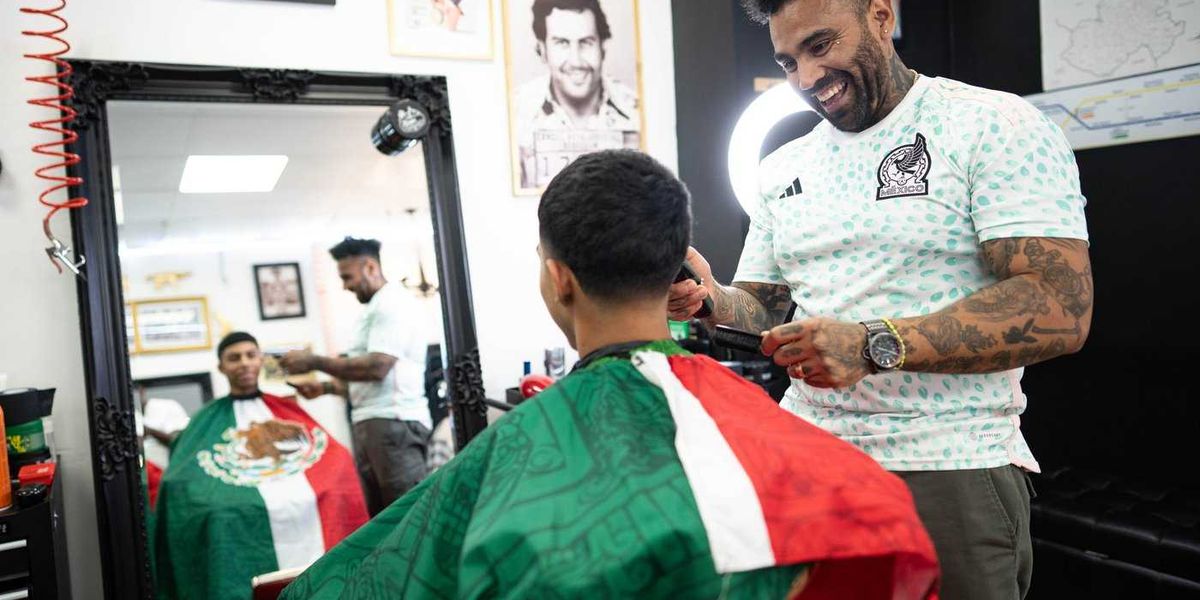
Pelayo’s shop, which opened close to BC Place Stadium in 2022, features gleaming brass and red-upholstered chairs, its walls covered in Latin American memorabilia, Mexican flags serving as barber’s capes. Customers include several members of the Vancouver Whitecaps.
Pelayo said “you can hear in the streets” that the number of Spanish speakers in Vancouver had been “growing and growing” — and along with it, a soccer fandom that is on another level.
“I feel it’s going to start to grow, the soccer community here in Canada, but we have (it) in our blood, Latin people, because your parents teach you,” he said at his shop.
Statistics Canada data says the Latin American population went from about 177,000 in 1996 to more than 580,000 by 2021.
The agency reported in 2024 that the biggest source countries were Colombia and Mexico, followed by El Salvador, Peru, Chile and Brazil.
Pelayo said his shop serves as a community hub for Mexicans and “all the Latin people,” but where everybody is accepted.
“We have customers — Canadians, Brazilians, Mexicans — (from) everywhere in the world basically.”
He said the Latin community is seemingly about to “grow a lot.”
“I mean, I came here eight years ago and now I have two kids and they are Canadians, but Mexican at the same time, right?” he said.
“The second generation, (it’s) like what happened with Chinese or Indians, but now what’s happening with Latin people,” he said, referring to Canada’s waves of immigrants over the decades.
Pelayo said he hopes the World Cup brings a wave of customers and a boost in business, thanks to its proximity to the stadium and short-term rental units.
Fernanda Jardim moved to Canada from Brazil in 2016, and she said her community of Brazilian friends in Vancouver has only grown since.
“I feel at home here as well. You know, we become family when you are living abroad and everyone is so open to help each other,” she said. “I don’t miss Brazil that much.”
She said she’s feels fortunate to be in Vancouver for the World Cup in 2026 after being in Rio de Janeiro for the 2014 tournament.
“I’m very lucky to be able to to attend two World Cups in the country I live in, twice in the same lifetime,” she said.
Jardim said many people have left Brazil due to corruption, and Canada feels very safe, but the language barrier upon arrival was difficult even with decent English.
“It’s very hard to express feelings, especially,” she said. “We are a very passionate people, so this is very hard.”
Jardim has taken time off work to enjoy the tournament, but she said she won’t be attending matches due to high ticket prices.
“I wanted to enjoy the city and the people and I’m going to watch the games, definitely, but not in the stadium,” she said.
Community advocacy group Latincouver is also gearing up for the World Cup, launching a “Latin Plaza Hub” for people to watch games at its office space in Gastown.
Allan Nejume, consul general of Chile in Vancouver, who attended the launch event last week, said “football is part of our DNA, it’s part of our Latin American culture.”
“In that sense, we’re very pleased that the World Cup is taking place here in Canada together with Mexico and the United States.”
Valeria Salinas, a marketing lead with Latincouver, said she came to Vancouver from Mexico City four years ago, and she’s happy that the World Cup is happening both in Canada and in Mexico.
She said she’ll be excited to watch Mexico’s home game against South Korea on June 18, as well as the match between Canada and Qatar in Vancouver on the same day.
She expects the difference between Canadian and Latin American fans will be on display.
“Mexican people love football. We feel it like inside, right? So, we get excited, we scream, we dance, we are super loud, to be honest,” she said.
“I think sometimes the Canadians are more like soft, what they’re trying to express. And the Mexican people, you just feel it and you just say it and just scream about that.”
This report by The Canadian Press was first published June 9, 2026.
By Darryl Greer | Copyright 2026, The Canadian Press. All rights reserved.
![3rd Aug: 30 Questions (2026), 25 Episodes [TV-MA] (6/10)](https://occ-0-1522-1001.1.nflxso.net/dnm/api/v6/0Qzqdxw-HG1AiOKLWWPsFOUDA2E/AAAABbp_kPmpcjj8qTvcThI-9Hz1-KKSvjdZjIUvEGq2elp1oMeKg2MqigRliuPlimGrNbMuUJluedpAgljcyQurPYxdI1ZpUF-on44Ue1Cakn1zGhG-JDJIX2Mqza8M6wtkPnN0mmbZQcQ1j74hyV3bTysTkVBlGcxYiTo8Z6IpD8K0QA.jpg?r=730 "3rd Aug: 30 Questions (2026), 25 Episodes [TV-MA] (6/10)")