





In a small town, where nothing really happens, K. works at VHS World, alongside her teenage friends (all misfits, according to the local twin bullies), and the boss, a middle-aged man who seems to have a (not so slight) pornography addiction. Nothing seems out of place, out of the ordinary 1999 small town life.
Having been given Jen’s, a former employee’s badge, K. settles in the status quo or being a no one, a “nothing,” as her manager labels her, solidifying the play-pretend that supports the entire service industry to this day. The routine continues until her crush, taken aback by seeing her still in the small town, in spite of her well-known potential, invites her to a party and, in a gallant exchange for her declining the offer, promises to come rent the tape of Shakespeare in Love, the biggest movie hit at that time.

JenXponential, written and directed by Renoir Kobashi and Mark Fogarty, music and lyrics by Renoir Kobashi.
An unexplained mistake in labeling the products, however, leads to the main character discovering that a recording of Hamnet has reached a clearly dissatisfied customer and, with impulsive curiosity, to taking it home. As if it were a direct address to K., the characters from the recording remind a female Hamlet, whose piercing gaze directly reaches the viewer, that she cannot mourn her father ceaselessly. Disconcerted by what she has seen, K. shares the tape with her crush, Paolo, but copying it (as rudimental of a practice as it can seem today) leads to them creating copies of… themselves. The very condensed action of JenXponential, shortly after, brings forward a multiplication of the bullies as well, the teenagers becoming increasingly more vile to the point where only one of them, the more intense and dehumanized one, survives.
The alternate personas are, in spite of physically identical, intrinsically different, coming from a universe where everything is possible, yet either not capable of taking initiative or simply so fascinated with their new world they do not care if the exponentially multiplying evil twin takes over.

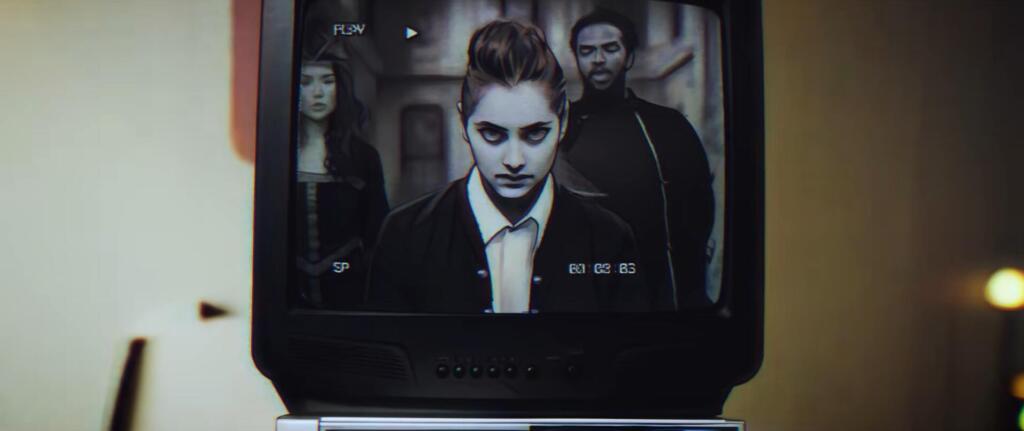
JenXponential, written and directed by Renoir Kobashi and Mark Fogarty, music and lyrics by Renoir Kobashi.
Although stuck in the downwards spiral of a terrible depression and still recovering from a failed suicide attempt, K., who, in parallel with Hamnet’s plot, seems to be mourning her father, starts to develop a plan. She expands her actions from the curiosity that brought her to watch and copy the tape to assign tasks to her friends and ultimately take a major risk in trying to defeat the ever-duplicating foe.
A story of regaining inner strength, JenXponential starts by dragging the main character along in what seems to be a self-developing plotline, eventually allowing the audiences to see a stronger K., willing, if not eager to fulfill her dreams, taking action to break free from the small town status quo. The production does not follow the typical musical structure, replacing the I Want song from the beginning with a more realistic take on life – having to make the best of one’s current situation, As If it were the desirable context. Playing with the characters’ fragility and countering it with their inconspicuous potential, this cine-musical illustrates the becoming, rather than being, without any form of play-pretending about the teenagers’ individual realities.


JenXponential, written and directed by Renoir Kobashi and Mark Fogarty, music and lyrics by Renoir Kobashi.
Right from the beginning, the animation style, with its vibrant, “happy” colors, contrasts strikingly with the characters’ boring lives, and the catchy, relatable songs seem to hint that there is much more to the story. A metaphor of the concept of “matrix”, the stylisation of the people’s features and costumes, their slightly lagging movement is not a complete reimagining of the real world, but a juxtaposition of computer-aided illustration and flesh-and-bones acting. Nobody, not even the bullies, is a cartoon or a caricature, they just happen to be drawn digitally over their natural contours, giving K.’s “escape” the nuances of breaking free from the world overtaken by computers, not only by exponentially multiplying teenagers who want to take over the world.
This short musical seems to act only as a prelude to the actual action, K.’s quest to see California “before she leaves this Earth” being the open ending that leaves the viewers wondering if the digital alter egos are actually not versions of the real people, but, in fact, yet-unseen and unexplored sides of themselves. Finding out the origin of her name, the main character is now ready to embark in what could be the journey of a lifetime, constructing a symmetry with the Shakespearean Prince of Denmark, both of them having to fulfill his destiny as if they were guided by an outside force.


JenXponential, written and directed by Renoir Kobashi and Mark Fogarty, music and lyrics by Renoir Kobashi.
Albeit experimental, not as a musical film, but as a play between the theatrical plot and the digital cinematic animation, JenXponential does not cross the limit of understandability, maintaining its plot and character development in spite of the technological inclusions which could have taken center stage. It keeps its humanity, although it could be, itself, copied and subjected to multiple interpretations generating doubles of the characters, like in a fractalic replica of the storyline, now transported into real life.
This post was written by the author in their personal capacity.The opinions expressed in this article are the author’s own and do not reflect the view of The Theatre Times, their staff or collaborators.
This post was written by Teodora Medeleanu.
The views expressed here belong to the author and do not necessarily reflect our views and opinions.