




The musical Les Misérables, written by composer Claude-Michel Schönberg and Alain Boublil (libretto and lyrics), premiered in 1980 at the Palais des Sports in Paris but failed to generate much interest among the French, despite being based on the novel of the same name by Victor Hugo. The concept album featuring arias from the show was more successful than the stage production. In 1982, the renowned British producer Cameron Mackintosh discovered songs from the musical Les Misérables and, deeming it worthy of the “big stage,” began working on an English-language version with Trevor Nunn and John Caird. A virtually new production (with a libretto by Herbert Kretzmer) premiered on the West End in 1985, followed a year later by a run in Washington, D.C. The Broadway show opened in 1987 and ran for sixteen years, becoming one of the three longest-running productions in Broadway history, alongside Andrew Lloyd Webber’s Cats and The Phantom of the Opera. The original Broadway production won eight Tony Awards, including the ultimate Best Musical.
In 2014, a new revival of the musical Les Misérables, which began in Toronto a year earlier, opened on Broadway; it was nominated for three Tony Awards in various categories, including Best Revival of a Musical.
The late 1980s marked the beginning of the musical’s triumphant march across the globe. It met with colossal success everywhere—except in France. Ultimately, the musical came to be regarded as far more “British” and “American” than “French.” As the show’s longtime producer Cameron Mackintosh put it, “no other musical in history has ever managed to pull off the hat trick of being a gigantic success on stage, film and the concert arena concurrently during its original world record-breaking run.“
Composer Claude-Michel Schönberg recounted the story of the musical’s creation and explained why it left the French indifferent.

Claude-Michel Schönberg/ Photo from Mr Schönberg’s Personal Archive
Lisa Monde: Les Misérables the musical has been around for so many years; it is extremely popular. Many European musical theatre composers name your musical Les Misérables as one of their absolute favorites. What inspired you to write Les Misérables? How did you come to create this masterpiece?
Claude-Michel Schönberg: Les Misérables was not the first musical show we did with Alain Boublil. I was a pop songwriter; he was a pop lyricist. After we wrote over 250 songs together, I felt bored with writing songs… Because it’s basically always the same… One day I just told Alain I was fed up with writing songs; I wanted to write something bigger and more important, where I could express everything. And after watching Jesus Christ Superstar in New York, Alain told me about two guys – Andrew Lloyd Webber and Tim Rice – and that they were like us – they used to be pop song writers, and they managed to create a musical with pop songs.
Alain is very fond of history. As Alain watched Oliver! in London, produced by Cameron Mackintosh, he noticed the little boy on stage – and immediately thought of Gavroche. So, we chose Les Misérables. As French people, we know the book by Victor Hugo very well. By then, there were already 32 movie versions of the story. We went through the book twice, then sat down to write our book, and the focal point became Javert’s chase of Valjean. We kept all the characters connected to those two leads. We took The Tempest in the Head by Hugo, 180 pages of the novel, and turned it into one song, “Who Am I.” I wanted the music to be stylized like the 19th-century music, because of the Romanticism and the exaltation of everything. I recorded the whole show playing the piano and singing all the parts. And that’s the recording Tom Hooper used to restructure the movie – because obviously the book is not the musical and the musical is not the movie. It was a huge success in France at first, but then we had to close and not much happened after. In France, the show business of musical theatre does not exist.
LM: What are the main differences between the productions in French and in English?
C-MS: Mainly, it was that in France we were addressing the audience who knew the story very well. So, in the French production, we started the action at the factory. After the flashback, we told the story of Jean Valjean becoming Monsieur Madeleine, but everyone in France knows this. We did an original cast album recording of the show in French.
LM: And, luckily, that recording found its way to Cameron Mackintosh?
C-MS: Yes. A young director from Manchester bought the recording after seeing the show while he was in Paris. He came to London to meet with Cameron, and they both listened to the recording. Cameron was surprised, because at the time he believed that “there is no such thing as French musical.” But Cameron listened to the recording out of curiosity. Later he told me: “I played the first track, and I was shocked… Then the second track – and I loved it even more than the first one.” Cameron said he only felt like this one time before, when he saw West Side Story for the first time. That was when Cameron decided he wanted our show to be his next project. Cameron found us in France through the French Society of Writers (SACEM). Cameron had already decided that the show would be directed by Trevor Nunn and John Caird, who had just done a production of Nicholas Nickleby. Trevor Nunn directed Cats, so Cameron trusted their professionalism. Cameron told me and Alain: “You don’t realize what you have written. You have a bombshell in the musical theatre industry on your hands.” He considered our French version to be a good “draft” for an international audience.
LM: Was the goal to simplify the plot for those who hadn’t read the novel? How extensive was the work involved in adapting the original version for an English-speaking audience?
C-MS: People around the world don’t know the story as well as the French people do; only very educated and intellectual people know of Victor Hugo, etc. Cameron wanted us to move to London for the next year so we could work on the show. So, in 1983, it all began. We worked with Trevor Nunn and James Fenton, and we rewrote the show together for an audience who may not know this story at all. James taught us a lot – he taught us how to build the characters, how to show where the character came from and their arc of development. He helped us establish the connection between our characters and the audience. And we had to “explain” what happened before the main events of the musical.
LM: Did the musical material undergo significant changes?
C-MS: We added 20 minutes of the opening sequence, which was not present in the original French show. I thought of an Overture, which is sometimes a medley of melodies that are present in the show. And I wrote the prologue as a medley of the coming songs, finishing with Valjean’s Soliloquy.
LM: Since there is a version in French and in English, which one do you like more? Which one do you think sounds better and works better with your music?
C-MS: It depends. French is a very “protesting” language. It’s harsh. So, in some songs like “Do You Hear the People Sing?” in French it is “À la Volonté du Peuple” – it means “By the Will of the People” – in English it’s still very good but doesn’t sound as harsh. There are other moments in the show where I prefer the English version. There was a new part written for the English show. We added the 20-minute introduction and Javert’s aria “Stars,” also “Empty Chairs and Empty Tables.” But even in the soliloquy of Jean Valjean, we see the perfect replica of Javert’s suicide. Because they reach the same state of mind when one decides to change his life and the other decides to commit suicide.
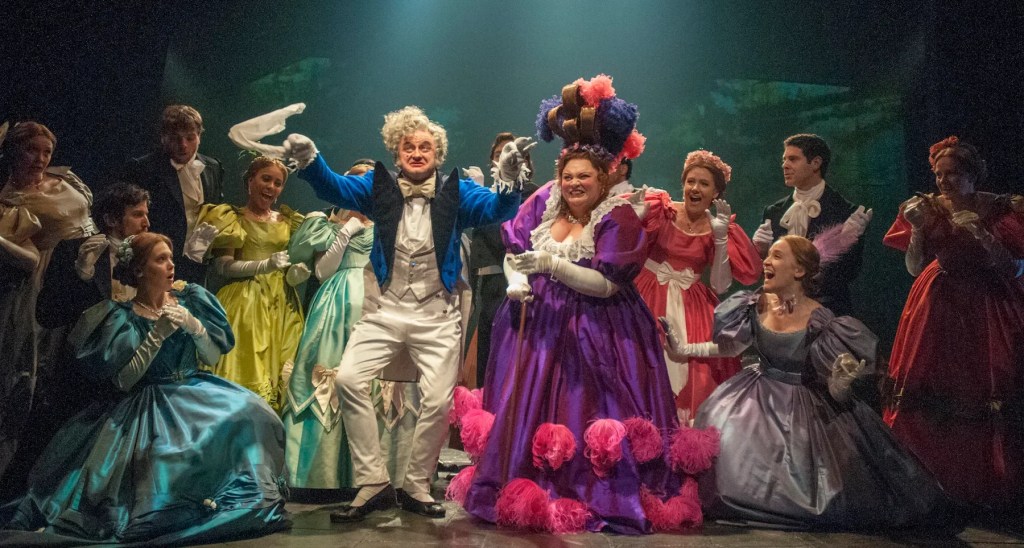
Les Misérables, Broadway Cast, 2014/ (L)- Cliff Saunders and (R)- Keala Settle as the Thénardiers/ Photo Credit by Michael Le Poer Trench
In 2012, Working Title Films, in collaboration with Universal Pictures, released the movie Les Misérables, directed by Tom Hooper. The star-studded cast included Hugh Jackman, Russell Crowe, Anne Hathaway, and Amanda Seyfried. The film received mainly positive and enthusiastic reviews. Les Misérables soared to the pinnacle of fame, winning Oscars in eight categories—a cinematic triumph unmatched by any other screen adaptation of a musical. However, the film had its “problematic” aspects, the resolution of which demanded significant effort from everyone involved in the production process.
LM: The movie Les Misérables is very different from the musical we see on stage. The actors in the movie sang with their own voices; most of them were not musical theatre performers. What did you think of the movie?
C-MS: Tell me what you thought first.
LM: I think that when it comes to musicals, it is always hit or miss – when you take a show everyone is used to seeing on stage and make a movie out of it. Most of the time, I prefer the stage versions. Of course, you can do more in a movie; nothing can beat a live performance. And even though the cast in the movie Les Misérables was amazing, I prefer the stage version. The approach taken by the director Tom Hooper was that he had actors sing for themselves– in some cases it worked, and in some it didn’t.
C-MS: You are absolutely right. Certain actors in the movie were cast without our consent as authors. Some performers were worrisome at first; I was on set to help the actors, and some didn’t want to be helped. There was one actor who, even in his acting, put himself above the director and was doing his own thing. I knew beforehand that some actors were great singers: I saw Hugh Jackman a long time ago in the musical “Oklahoma;” I knew that Anne Hathaway’s mother covered the role of Fantine in the original tour of Les Miz, and at 7 years old Anne followed her mother and knew the show by heart even then. I saw Anne opening the Oscars some years ago, so I knew that she could sing. Same with Eddie Redmayne; I saw him in a play in London, and we became friends ever since; I knew he was a talented singer as well. It’s the approach of the movie that didn’t work; the production company and crew didn’t want anyone in the cast who had previously been involved with the show. Tom Hooper had a brilliant idea when he said he didn’t want any singing prerecorded. He wanted actors to sing live on the set. And we had a brilliant sound engineer, who won an Oscar for his work on this movie. That’s when I told the producers and Tom that if that was the approach they were going to take, I needed to be on set every day and agree with what was being done. We came to an agreement. So, I spent all my time on the set. Some days I gave the performers my blessing; other days, I hated what they were doing. I wanted to avoid editing and for all takes to be perfect. But the production didn’t have all the time in the world. So we worked with what we had. It wasn’t an easy process. I’ll be honest: I didn’t enjoy it. In the staged show, you have a common meeting point: the stage, but in the movie, people can be in the same cast and never even meet. Everyone would be glad they got through two minutes of a scene in one day – to me it was strange. But they said that editing would fix it all. I think that was not true… After they edited the movie, we had the screening – it was like a funeral of the show… It was so bad. The main editor was editing the words, not paying any attention to the music… Cameron, Alain and I told the production they had to realize it was a musical movie first and foremost. They hired a new editor who spoke to us, understood what we thought was important, and did a good job. But I taught her about a very important thing – which most people don’t even think about – the rhythm of the silence in a musical movie. When you finish one song, one thought, there needs to be a breath, a thought, a change before the next song. The score needs to breathe; you can’t compress it. We did what we could. Some parts could not be saved, of course. There is a new sound system installed in some movie theatres – the Dolby Atmos Sound System, and it makes everything sound more balanced and different. In February, they are going to relaunch the movie and play it in the movie theatres with this sound system – in the end, it doesn’t sound so bad.
LM: Do you think the movie brought more people to the live show?
C-MS: Yes. The movie was a huge public success. At the screening in America and Australia that Tom Hooper went to, people were actually applauding. It was a huge success worldwide, except in France. Millions and millions of people saw it. It’s like when Susan Boyle sang the song from the show, and people started clicking and clicking on YouTube… They learned that the song she sang came from the musical Les Misérables. So, all of Susan Boyle’s fans came to see the show. For Susan, it was not that she sang it better than others, but the song resonated with her; it became her story – she was dreaming of another life. That’s when I realized how important words are. In her case, the words cut deeper than the melody. She was living the song.
Over the musical’s forty-five-year stage history—dating back to its world premiere—a fine tradition has emerged of marking Les Misérables anniversaries with large-scale concert productions: the 10th Anniversary Concert (1995), the 25th Anniversary Concert (2010), and the 35th Anniversary Staged Concert (2019–2021), along with subsequent tours. Despite the pandemic, The All-Star Staged Concert successfully reminded audiences of this beloved musical.
Today, the musical Les Misérables—which has seen over 60,000 performances across various stage productions—continues its triumphant global run as an unstoppable hit. How does its creator envision the future of this multi-award-winning show?
C-MS: The future of Les Miz is beyond me. The baby grew up; it has its own life. It’s playing in 7 countries worldwide. We had twenty-three translations of the show. More than 215 million people saw it. Many people want to do it in concert at the most prestigious locations on earth. We’ve been at the same theatre in London for 35 years; we had to redo the roof there… So, we stopped the show and decided to do the concert version as we did for the 10th and 25th anniversaries of the show, on a smaller scale. We did an All-Star Concert for six months at the Gielgud Theatre [another theatre belonging to Cameron Mackintosh]. And it was sold out.
LM: You have created a masterpiece, which will live on for many years to come. It is your musical monument!
C-MS: But that is thanks to Victor Hugo! We all know Javerts and Thénardiers; there are some Cosettes out there. These characters are universal and very recognizable.
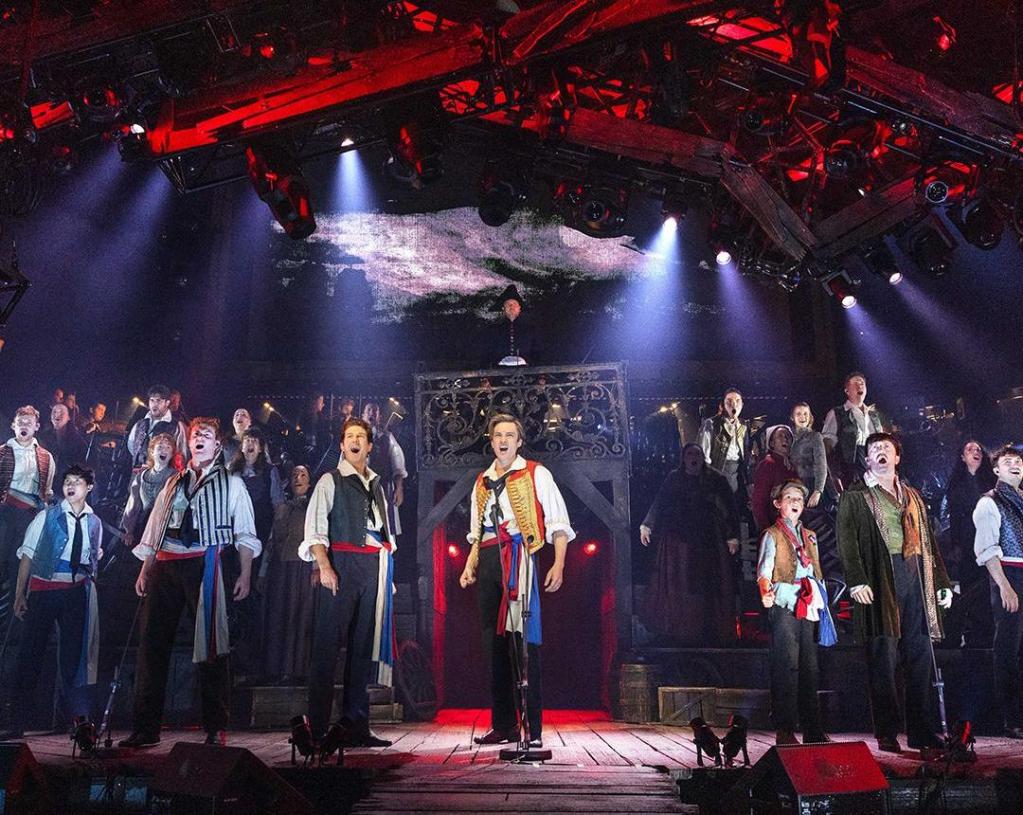
Les Misérables: The Arena Concert Spectacular/ Ensemble / Photo Credit by Danny Kaan
The World Tour of Les Misérables: The Arena Concert Spectacular, marking the 40th anniversary of the musical’s English-language version, kicked off in Belfast in September 2024. The composer took an active part in the preparations.
The tour concluded at the Radio City Music Hall in New York. Around one and a half million spectators across seventeen countries saw the show! Claude-Michel Schönberg flew to New York to see the Les Misérables: The Arena Concert Spectacular production at Radio City Music Hall firsthand, and this is what he had to say about it:
Since the beginning of this incredible project, I have been involved from the very start, beginning in Belfast. We were all surprised by how well the concert worked, despite having no set or staging. The quality of the audience’s listening was miraculous, and the standing ovation from 6,000 people was so moving! We hadn’t imagined this large-scale version would work. Of course, we had the best people for each character, and every time this arena production was performed, it received a wonderful reaction from the audience.
We asked director Jean-Pierre Van Der Spuy to comment on the creation of the new Les Misérables: The Arena Concert Spectacular musical format.

Jean-Pierre Van Der Spuy / Photo from Mr. Van Der Spuy’s Personal Archive
Lisa Monde: We’re once again celebrating the anniversary of Les Misérables, and it seems to have become a tradition to celebrate Les Miz with big events and concerts where we pay tribute to this beautiful creation, the music, and the story! It allows us to experience it all over again. I know that you worked on the previous concert version as well, correct? In 2019. What is new in Les Misérables: The Arena Concert Spectacular compared to the All-Star Concert marking the production’s 35th anniversary?
Jean-Pierre Van Der Spuy: In 2019, Cameron [Mackintosh, producer] closed the West End production because he was refurbishing the Sondheim Theatre. And because he wanted to keep Les Miz running, we moved next door into the Gielgud Theatre and created a concert version. That’s how I came on board with the production. James Powell and I are co-directors of the concert, and James has had a long association with the production. He directed the current West End production. Cameron asked me to join the creative team: “Just to have a different perspective, a new eye on things,” and that’s how I ended up joining forces with James Powell to create that concert version at the Gielgud Theatre. That concert version was different from the current production you saw. That said, there were other anniversary concerts, which were also super impressive.
LM: So, the version that played at the Gielgud Theatre is a concert version. Was there a reason why Les Miz was turned into a concert version rather than just a regular production of the show?
JPVDS: Well, the Gielgud Theatre is a lot smaller than the Queen’s Theatre, where the show played originally. That was a very practical reason. And I think Cameron decided there was an opportunity to do something a little bit different. The 25th anniversary concert was a huge success, and Cameron wanted to create a concert in a theatrical setting. We got a fantastic cast: Alfie Boe, Michael Ball, Carrie Hope Fletcher, and Matt Lucas… But also, the book of Les Miz, the source material, is so strong! The music is incredible, so even without all the bells and whistles of a full production, it still stands on its own and seems emotive.
LM: What are some major differences between the arena concert spectacular show that we saw in New York recently and the latest West End version of Les Miz?
JPVDS: Well, we had no screens. Musically, the show is very much the same. The edits we made at the Gielgud were preserved. The cast rotation worked a bit differently. The set and the lighting design are different. The arena spectacular has an unbelievable lighting plot- what they were able to do with the cross beams – using the light to create the setting for the inn, for example, is terrific… I’d say what we had on West End was a template we worked from, but we knew we needed to adapt it for the arena show.
LM: When I first heard of the arena concert spectacular, I thought it would be a medley of songs from the show performed by several casts at the same time. I was surprised at what I saw! It is not your typical concert version. It is basically the show; it follows the book of the musical. The sequence of musical numbers is accurate as well. Because there is no set as such and no scene changes, the spectator can focus fully on the beauty of the music and story.
JPVDS: That was exactly the point. When we were starting rehearsals, we told our actors: “Yes, it’s a concert. We want you to bring something of yourselves to the material,” so it’s not always 100% driven by character. You can sense the performers in all the characters. However, it was still very important that the core of the characters would remain. When it comes to the overall arc of the show, we have cut some things, but we wanted to make sure that the storyline remained as it was in the original show.
LM: What were some of the main tasks you set for the actors?
JPVDS: We allowed the actors to really bite into their text, imbue the language as much as possible, and to almost deliver those solos like soliloquies, Shakespeare-style. We wanted to preserve the emotion, the dramatic intent behind everything. The performers are really connecting with the audience, unlike in a stage version where you’re working with the fourth wall.
LM: Did Claude-Michel Schönberg, the author of Les Miz, participate in this production? Was he present at the rehearsals, throughout the process?
JPVDS: Very much so! What I love about Claude-Michel is that he is truly an Artist, and he really looks after his work. He knows exactly what he wants, and his taste is immaculate. But he also has the ability to move with the times: he constantly reevaluates, listens to new ideas, and sees how things can be adapted, keeping the integrity of what he wants as a writer while also listening to the new approach to the show. With the concert, he was very much around. And he loved the idea that this show was going to be performed at arenas that are normally home to big pop stars. So, the idea of allowing actors to bring a little bit of themselves, of their own flair, to him felt appropriate. And if somebody went a bit too far, he would say, “I’m not sure that’s quite right.” But he also encouraged people, from his perspective, to go a bit further. Since this is a celebration! Celebration of Les Miz!
LM: Did Claude-Michel Schönberg give you complete freedom regarding the choice of the show’s format and its specific details?
JPVDS: Claude-Michel is very open and creative; he comes to us as much as we go to him for advice. So, there is this lovely sort of mutual appreciation and respect. I consider myself extremely lucky to have worked with the creator of Les Miz himself! Claude-Michel moves with the times, interrogates, improves, or shifts things because tastes and theatre have changed. I love that Claude-Michel is asking questions and finding answers to our questions… And we’re discovering things together. We’re so lucky to have this three-way conversation between the writer, director, actors, and sometimes designers, sound designers, and the rest of the creative team. It’s incredibly rewarding!
LM: With the way the stage was set – rock concerts inspired it; you could tell. As I watched, I kept flashing back to rock operas, especially in moments when the performers sang facing the audience or walked onto the thrust stage into the audience for key moments of the show. What especially stood out to me was the scene of Javert’s death. I remember in the musical: it happened on the bridge, at the backdrop, and here we get the opportunity to see it all right in front of us, in the audience… with those beautiful close-ups projected onto the screens. To think of it, Javert was standing there, technically, but it was such a breathtaking moment.
JPVDS: Absolutely. Sometimes those things are so simple. For us, when we were working on the show, it just felt like “that was the way he had to go.” He had to move forward to the precipice of his decision, to jump, and obviously in a show it’s normally because of technical reasons the other way around. But luckily, because we’re in a concert, the freedom to keep moving forward was beneficial. We don’t have to show the end. Let’s watch that moving down the plank moment… And that is very sort of confronting, paired with the intensity of seeing the actor’s eyes on the screens; yeah, it was an exciting moment!
LM: I was curious about the videos that were implemented into the show. From what I understand, what we’re seeing on the screens is live footage. And that’s complicated enough in the technical sense… The actors need to be aware of the cameras directed at them too. But then there are videos that, I would assume, were pre-shot as well?
JPVDS: Yes… We’ve got two things going at the same time. All the content where we see the actors’ faces, or where they’re in the scenes, is pre-shot. And then, for example, in the convicts’ scene, when we first start the show – we filmed our actors coming out of that tunnel, so the audience could see the shadows moving. In Lovely Ladies, we did something similar: we filmed all the girls in silhouette to amplify what was happening. But most of the time it’s live feed. We also have a very talented team working on projections, where they can take the live feed from the two cameras stationed on each side of the stage and overlay it with special effects in real time. We also wanted to make sure that in key moments, like Fantine’s or Eponine’s death scenes, the projections stop and the screens are off to keep the audience’s attention on the intensity of the moment happening on stage in front of their eyes. So, we tried using the videos and projections as a storytelling device.
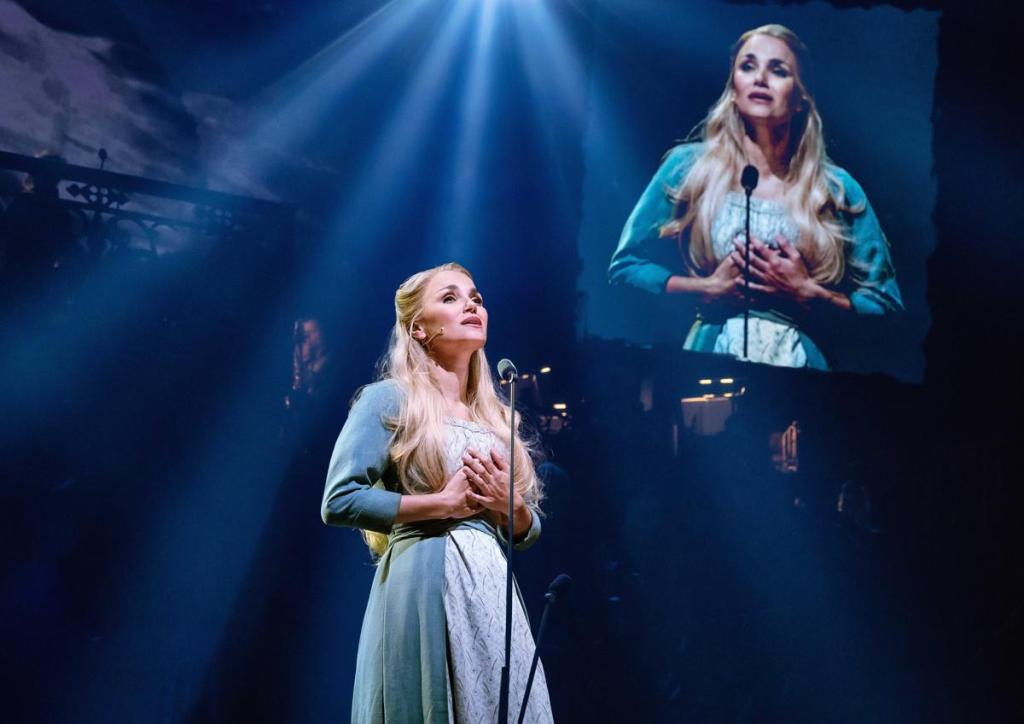
Les Misérables: The Arena Concert Spectacular/ Samantha Barks as Fantine/ Photo Credit by Danny Kaan
LM: Did you have to make many technical or staging adjustments when you moved locations?
JPVDS: Yes, we adjusted depending on the location—many of those adjustments related to the company’s focus: where they were delivering their lines. Sometimes we needed to adjust the staging. When it comes to technical adjustments, the team and Chris Boon, the production’s technical director, were phenomenal at making sure all adjustments to the lights, cameras, and screens were done before the cast arrived on set for rehearsal. Some locations have a rounder space, and we may have the audience members sitting on both sides of the thrust stage, for example. Then we adjust, and the actors must adjust their angles. So, the production is truly living and breathing and constantly changing.
LM: Is it the same cast that travels throughout the tour? Or do you have alternate casts?
JPVDS: The ensemble company for the tour was divided into three legs. There’s a leg one, a leg two, and a leg three. Everyone in the company has done the show before. The cast alternated throughout the year. But everybody in leg three, which started in Dublin probably six weeks ago, that’s the same company that came to New York. We have our standbys for principal roles within the ensemble. It takes a village; we have 28 people in the orchestra, all the crew backstage, the whole tour management team.
LM: Let’s talk about sound design. You have the live orchestra; everyone is mic’d up, there are also microphones on stands downstage, sound effects… How does it all work from the technical point of view? How many people are on sound duty throughout the show? Has anything been pre-recorded?
JPVDS: It’s cued. We have a DSM [deputy stage manager] – Rachel, and she runs the show. So as the show starts, she calls all the lighting cues and sound effects. And then we have two separate sound teams. One team mixes the show for the audience from the house, and on both sides of the stage, another team mixes the sound for the actors. We had to decide how to ensure everyone got a consistent sound while singing; with delays in big venues, it can be tricky. So, we got everyone earpieces. But everything is happening live. It’s just brilliant.
LM: The Les Miz concert tour traveled around the world. Was the show always in English, or was there a French version in the French-speaking countries?
JPVDS: Always in English. But when the show was in Japan and China, what I think is amazing is that the little girls who played little Cosette were Japanese and Chinese, and they learned ‘Castle on a Cloud’ in English, and they were absolutely amazing. They barely spoke English, but they learned the song phonetically, and it was just brilliant. Gavroche traveled with us. But for the role of little Cosette, we picked our actresses locally, at every new venue. So, for example, when we were in Australia, they were Australian Cosettes. In Japan – Japanese. In Manila, for example, they were Filipinos. In New York, the three little Cosettes are all American.
LM: The arena concert spectacular is a cross-genre between a concert and a musical. Do you consider it a new genre that you’ve created? And do you think it’s something that will keep developing?
JPVDS: It may be this quasi-theatre concert thing, so I can see why some people are saying that it is its own genre. I wonder what other shows could deliver in the same way… It needs to be a sung-through show. It must have enough within the songs themselves to keep the drama unfolding clearly on its own. It really depends on the source material.
The creative, multinational production team succeeded in creating a mesmerizing, large-scale show. In many ways, it resembles the concert version of the French rock opera Starmania, created for a 2024 national tour marking the 45th anniversary of its premiere. Although this is not the first time a musical has been staged for large arenas globally, Les Misérables: The Arena Concert Spectacular can be considered a new media form of adapting Victor Hugo’s classic novel of the same name.
The harmonious blend of theatrical and concert formats made it possible to fully convey the story and the characters’ emotions, with music serving as the primary storyteller. The chamber symphony orchestra, positioned on stage, brilliantly rose to the challenging task of making the story accessible even to the uninitiated.
The orchestra became a full-fledged participant in the dramatic dialogue. In the absence of full-scale stage action, the main characters’ leitmotifs served as a calling card and carried significantly more weight than their theatrical counterparts. The original orchestrations (John Cameron), combined with new ones (Stephen Metcalfe, Stephen Brooker, Christopher Jahnke), created a sense of sonic scale and enhanced the score’s emotional depth. Despite the dense arrangement, the vocals remained the primary focus. This balance between instrumental and vocal elements—achieved by sound designer Mick Potter—was particularly crucial during dynamic crowd scenes, which featured sound effects such as gunfire and explosions.
The visuals left no one indifferent; they are seamlessly integrated with the stage space. Close-ups of the performers, framed in gold, are projected onto the screens on both sides of the stage. Various images constantly appear on three large screens, serving as the main backdrop. At times, the screens begin to command more attention than the relatively static action on stage. The visuals (by Finn Ross) are aesthetically precise, emotionally reinforcing the unfolding drama. Video installations create a deeply immersive experience, placing the action against backdrops such as cityscapes and barricades. The audience is treated to a captivating visual experience that leaves a lasting impression.
And certain scenes—for instance, Javert’s Soliloquy aria and his suicide—unquestionably surpass the corresponding scenes in any stage production in terms of emotional impact.

Les Misérables: The Arena Concert Spectacular / Jeremy Secomb as Javert / Photo Credit by Zeus Martinez
In a minimalist setting, lighting transformations serve to define the location (prison, barricades, church, tavern, city streets), the time (bright daylight, night, twilight), movement (crowds, fire), and the character’s emotional state (via lighting nuances). Lighting also makes it possible to alter the perceived scale of action, ranging from expansive scenes to intimate moments.
As with other arena versions of musicals—such as The Phantom of the Opera (2011)—the set design and stage space are built around the iconic imagery. In The Phantom of the Opera, these are the underground lake and the chandelier; in Les Misérables: The Arena Concert Spectacular, the barricades fill this role. They are arranged in tiers across the stage, with the orchestra positioned on the upper level, and the ensemble taking their spots among the descending barricades.
At one point, the movable overhead lighting structures assemble into a metal barricade framework across which the revolutionary rioters move, underscoring the epic scale of the action. In this new production, the barricades can rightly be considered not merely a prop, but a “character” that has become an integral part of the show’s cultural DNA.
The ensemble remains on stage throughout the performance, portraying common people, revolutionaries, students, and other participants in various scenes. Despite the minimal set design, the ensemble succeeds in conveying the progression not only of the plot but of history itself.
Virtually the entire cast consists of performers who have previously been involved in the project—whether in its major stage or concert versions or on tour. They arrived from various countries—including Alfie Boe (UK), Killian Donnelly (Ireland), and Geronimo Rauch (Argentina) as Jean Valjean; Bradley Jaden (UK) and Jeremy Secomb (Australia) as Javert; Samantha Barks (UK) as Fantine; and the wonderful Thénardier duo of Matt Lucas (UK) and Marina Prior (Australia)—to share with the audience not only magnificent renditions of beloved arias but also their love for a show that has become a significant milestone in each of their artistic careers.
Songs from the musical Les Misérables have long taken on a life of their own. Over the past forty years, musical numbers such as “I Dreamed a Dream,” “One Day More,” “On My Own,” “Stars,” “Do You Hear the People Sing?” and “Bring Him Home” have been performed by the finest vocalists of the modern era and have become part of the commemorations of significant historical events, both in the United States and abroad.
At the very inception of this legendary project, Cameron Mackintosh spoke prophetic words to Claude-Michel and Alain: “You don’t realize what you have written. You have a bombshell in the musical theatre industry on your hands.” Thanks to Victor Hugo, Alain Boublil, Claude-Michel Schönberg, and Cameron Mackintosh, generations to come will be able to enjoy the magnificent music and experience the story of the conflict between Jean Valjean and his arch-nemesis, Javert; to grasp the tragedy of Fantine and rejoice in the ultimate fate of her daughter, Cosette; to admire the courage of young Gavroche; and to shed tears of both pity and tenderness as they share in the characters’ turbulent life journeys.
Why are spectators ready, time and again, to encounter the characters of Victor Hugo—characters who first came to life on the musical theatre stage over 40 years ago? Because the musical Les Misérables remains as relevant today as it was at its inception. And it will remain so as long as global demand for social justice and empathy for the downtrodden and the outcast grows. MIZ ROCKS!
Dedicated to the 40th anniversary of the English version of the musical.
This post was written by the author in their personal capacity.The opinions expressed in this article are the author’s own and do not reflect the view of The Theatre Times, their staff or collaborators.
This post was written by Lisa Monde.
The views expressed here belong to the author and do not necessarily reflect our views and opinions.