







It’s been six years since the end of Managed Approach, a project in Holbeck, Leeds, which managed a red light zone in 2014, before it was paused during COVID in 2020 and not reinstated in 2021. During the scheme, the local communities were divided over the sex workers’ presence on the streets, outraged that they could legally ply for trade in full view of local families, despite caveats from the council that workers must avoid residential areas and not engage in drugs or with organised crime.
This play, which takes its title from the project, explores contrasting responses to the scheme in a drama about mother and daughter residents Kate and Abbie, put alongside verbatim testimony from the sex workers themselves. In doing so, it creates a new landscape where 4th wall drama meets verbatim theatre, exploring the meanings of community, safety, and intergenerational feminism.
First performed in 2024, the show is on a UK tour following its run in Edinburgh last summer. It has had an unusual beginning – having been conceived out of a Cambridge University course, where the brief was to write a play. Student and playwright Jules Coyle, who also plays Abbie, decided to write about what she knew from her experience growing up observing the Managed Approach, as well as about Leeds’ history with the Yorkshire Ripper and Reclaim the Night marches.
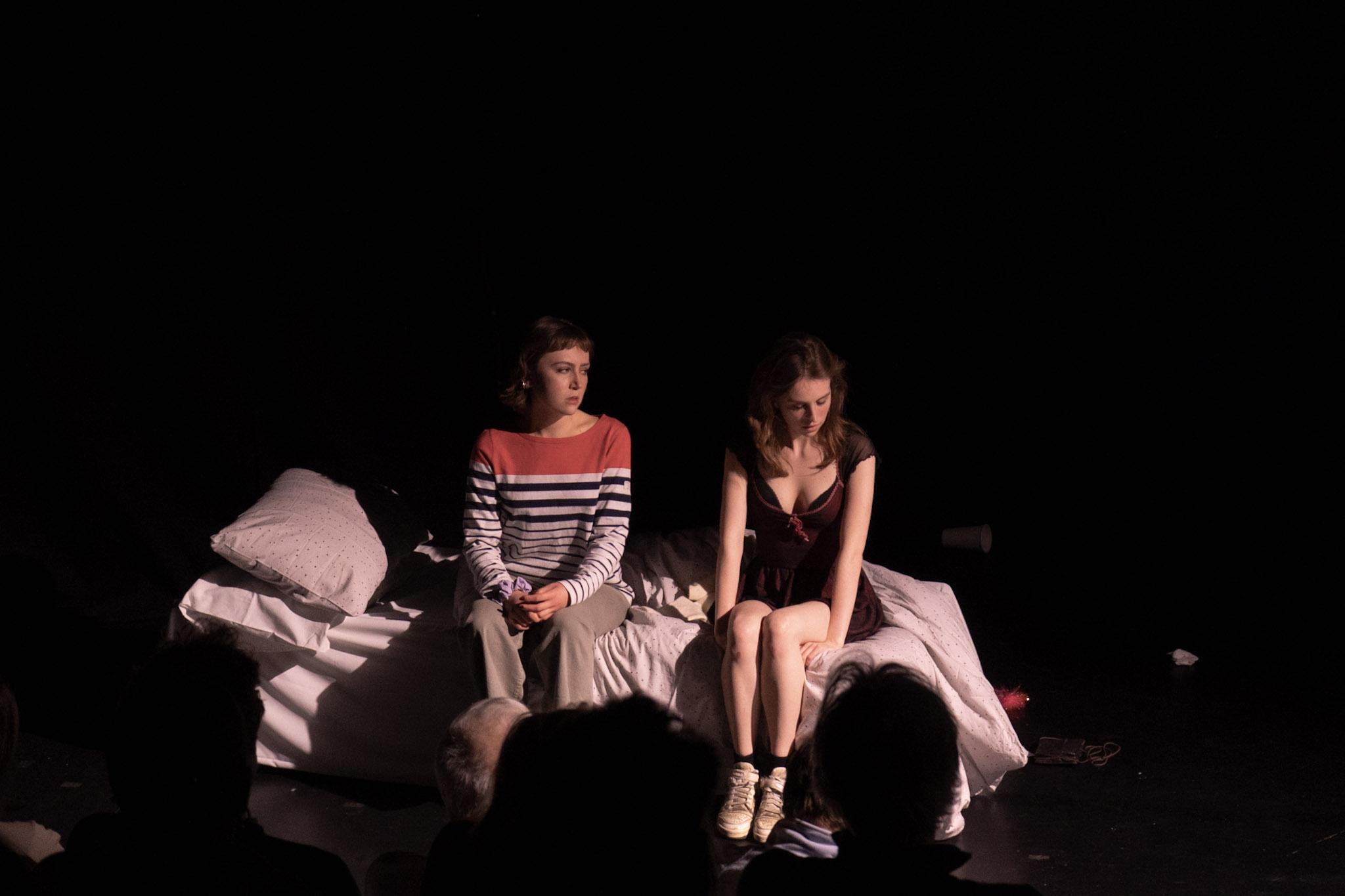
At the Riverside Studios in London, Lily Ellis, the director, has the drama unfold on a symbolically partitioned stage. On the right, a chair and carefully placed microphone denote where the actors, recounting the sex workers’ words, will sit. A single spotlight sometimes marks out the stage space allotted to them. On the left, and creeping over the middle stage into this space, is Abbie’s unmade bed. A duvet in a heap, clothes, bras, tops, etc., strewn across the floor like the tokens of bread left as markers in Hansel and Gretel and towards the sex workers’ chair – although, if anything, Abbie appears to be going the way of Shane in Jim Cartwright’s Raz, such is her desire to have a good time. At first, oblivious to the Managed Approach, she’s all mouth and loud volume.
But the scheme raises dark issues for Kate – not least the fear of her daughter either being attacked by a sex worker’s client, or even being drawn into sex work herself. Her mind is spinning with the horrors brought by the Yorkshire Ripper, who terrorised Leeds and West Yorkshire when she was a child in the 70s/80s and made the streets unsafe for women. 40 years on, he still haunts hearts and minds. It’s this, to the soundtracks of Bowie and Nancy Sinatra, and the memory of the first Reclaim the Night march, where women protested about being served curfews to keep them safe from the Ripper, which drives Kate. How has the world changed for her? Yet again, she thinks, women can’t walk safely on the streets of Leeds, this time because of the men coming to see the sex workers. It’s why she unwittingly becomes censorious, paranoid about checking up on her daughter every time she goes out clubbing. It is also why she begins an online naming campaign to identify the sex workers in a bid to shame and stop them.
But the drama starts with the sex workers. They take turns being interviewed by phone, making it all a bit atmospheric and cloaky, like in a well-made documentary. No matter how much they are brought into clearer view in the public sphere or on stage, they remain a bit distant.
This is why the staging works so well. It is easy to see that the world Kate and Abbie inhabit is privileged and authentic. And there is always a sense that Kate and Abbie’s lives will enter and overlap those of the sex workers (as indeed they do), but not the other way around.
When the two worlds do overlap, when a sex worker, Rachel, helps Abbie out of a spot of trouble, it is the beginning, it feels, of Abbie’s political and compassionate awakening.

Àine McNamara in Managed Approach, credit Charlotte Conybeare
This is the turning point in the play and paves the way for the clash between mother and daughter, which you always knew was coming – Kate can’t understand Abbie’s empathy for the sex workers, can’t understand, and perhaps is even jealous of Abbie’s lack of fear for her own wellbeing. For her part, Abbie does not understand Kate’s historical past or where Kate is coming from. But it is also the moment where a sex worker feels the most authentic, the most fully rounded and her portrait the most intimate – even if the moment where Rachel helps Abbie is totally made up. As she eventually acts as a bridge between Abbie and Kate, how are audiences meant to respond to this Rachel moment? I found myself pondering this- if the verbatim testimonies weren’t included in the play, would it change how the audience responds to Rachel, or, if the moment with Rachel, no matter how true, weren’t included, would it impact how an audience responds to the sex workers?
The mother-daughter drama upholds the 4th wall. But the testimonies of the sex workers, as presented carefully by actors Àine McNamara and H Syned, break it. In this gap between the two genres, something is happening. Questions must be asked about where truth and the imagination, in relation to human experience, overlap and how they bring depth and understanding to a work of art and its themes. I found myself asking how I would have experienced the play if the sex workers were written into the 4th wall drama and were made into fictional characters. Or what if Kate and Abbie became Kate and Abbie in real life and were presented using verbatim, the playwright having researched and collected testimonies from those against the scheme to be presented on stage?
Either would have made for a less complex play. And it would have been harder to feel or understand a certain truth which comes out of the Managed Approach, which is that society clearly still thinks, including some women, that some females are more deserving of being kept safe than others. Safety is the chief concern for all the women in this drama.
This is illustrated by some repetitive refrains. Abbie, Kate, and the sex workers keep going on about how safe or unsafe women are. They keep saying, “I was worried about you“ or “I am worried about your safety.” This has to be because the women feel that they aren’t being heard enough.
At the end, Kate and Abbie seem to have gone on a journey in terms of understanding each other’s feminism and personal histories. But the journey for the sex workers is less clear. Initially, I thought this muddying and inconclusiveness to their story made the show less than it could be – I certainly think that the sex workers’ stories could be pushed a bit more daringly and given more of a centre stage. But the sense of inconclusion with the stories of the sex workers brings about a realisation. Some stories, usually made-up ones, mostly resolve in some satisfying denouement. But some, especially non-fiction ones, don’t realise this and hang unfinished. Is it a privilege to be able to conclude one’s story? And a lack of privilege to be left waiting for society to recognise you?
Managed Approach is a play from the new theatre company Open Aire Theatre. It will be interesting to see what’s next for this young group of talented creatives and actors.
This post was written by the author in their personal capacity.The opinions expressed in this article are the author’s own and do not reflect the view of The Theatre Times, their staff or collaborators.
This post was written by Verity Healey.
The views expressed here belong to the author and do not necessarily reflect our views and opinions.