![24th Aug: Mobsters (2012), 5 Seasons [TV-14] (5.95/10)](https://occ-0-171-92.1.nflxso.net/dnm/api/v6/0Qzqdxw-HG1AiOKLWWPsFOUDA2E/AAAABa90uG2hY8uSK-LIPXlYr_GK0WfkNWew5C-9meYolqAzmKx6Agge0DzuprsKxbGwaY9we2_sHHOR9FsTIRHJDqCSV5o4ZMfIOGFtmb2Vt-m_Fgm9b7bIh6-ZZ0_Ps7Q2hgXMFg86pUb5nEHI74Mii-fPyygDJ_pNybh8Fvn1JBa0cg.jpg?r=bcc "24th Aug: Mobsters (2012), 5 Seasons [TV-14] (5.95/10)")




Rudolf Steiner (1861-1925) is recognized internationally as the founder of anthroposophy, which, in turn, defines itself as a spiritual – philosophical worldview, not a religion. Steiner’s writings have been edited and published, and his own body of knowledge has been expanded by his followers. As with any world-wide body of knowledge, how much, and what precisely, is genuine, true, original Steiner and how much and what precisely represents interpretation, potentially misrepresentation, by Steiner’s immediate followers and / or the organization now maintaining his heritage, would need detailed historical study, if indeed it is considered to matter.
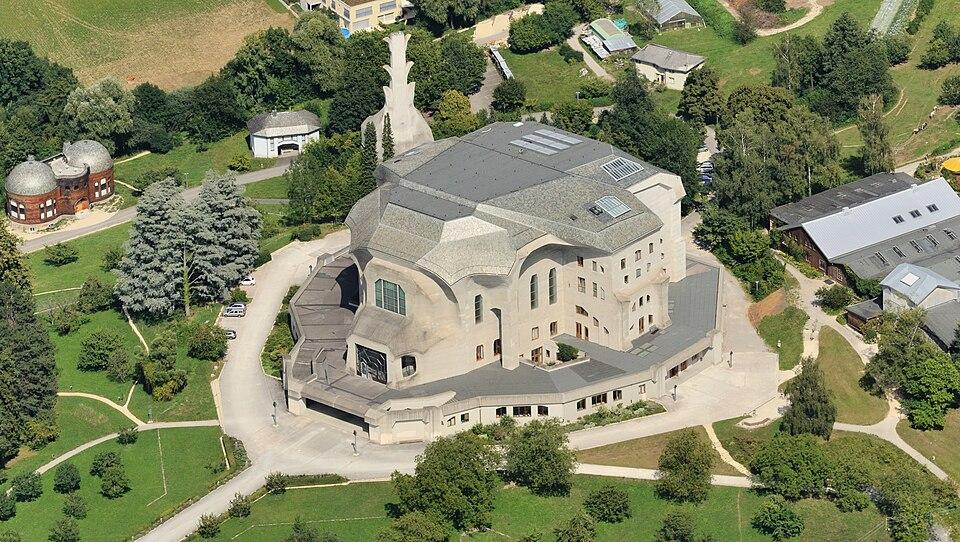
The organization around Steiner’s knowledge is the Anthroposophische Gesellschaft, with its headquarters in the Goetheanum in Dornach, Switzerland. At the core of this area is a massive and impressive building of the same name. The original building, created between 1913-1922 but destroyed in a fire in 1922, was replaced by the extant concrete building created between 1925-1928. Both buildings were modelled on the basis of Steiner’s designs. It might be worth comparing the extent to which Wagner was involved with the creation of the Bayreuth Festspielhaus and the extent to which Steiner was involved with the creation of the Goetheanum.
The building at the core of Steiner’s organization takes its name from Johann Wolfgang von Goethe (1749-1832): Steiner was inspired by Goethe’s writings, and the relationship of Goethe’s philosophy and the core of anthroposophy has been studied extensively.
Against this historical background, a production of Goethe’s magnum opus, Faust, in its entirety of Parts I and II, at the Goetheanum must be considered a major undertaking. The very first time Faust was staged at the Goetheanum had been in 1938, with many subsequent years during which the play was staged uncut, with 18 hours of performance time over three days. The current, cut production was first presented in 2020, and has been revised and enhanced annually since, at times with considerable cast changes.
Three complete performances of Faust I and Faust II were presented in 2026, two over a three-day period, one, seen by me, over one weekend. Faust I on Saturday, with 4 hours of performance and one hour intermission, and Faust II on Sunday with five hours and 15 minutes performance time and three hours and 30 minutes of intermission. Altogether, this adds up to nine hours 45 minutes performance time and four hours 30 minutes intermission.
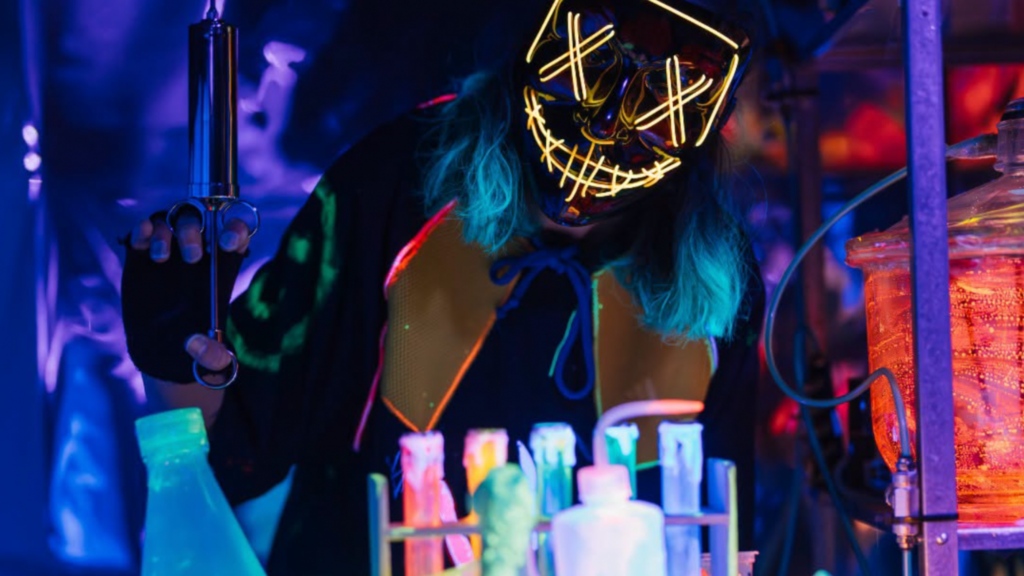
The set designed for the huge stage was kept symmetrical and simple, with broad demarcation of space through curtains of varying density and color. For individual scenes, smaller set elements were wheeled in: a wall of bookshelves for Faust’s study, and small indications of interior spaces with half a room for Gretchen and Frau Marthe, respectively. Outdoor spaces were given occasional further playing areas by having a large cube and a slope leading up to it, which could be rearranged in space by stagehands during scene changes, or by the performers themselves. Scene changes and changes of scenery within scenes took place efficiently and were well integrated into the flow of the plot. Generous lighting, again making use of the full range of available technology, including effects created by a fog machine and a display of laser beams at the back of the stage for the scenes of devilish excess added to the overall atmosphere of the production.
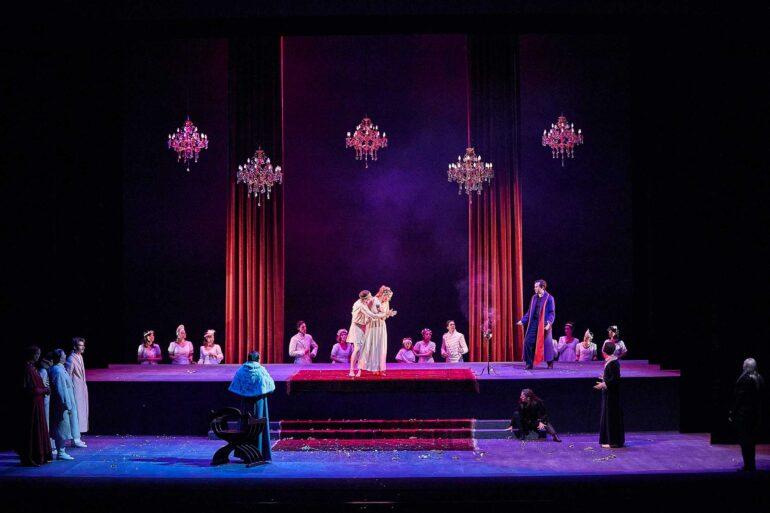
Photo credits: Laura Pfaehler.
The first few lines of the play, up to the entry of Faust, were lost in so far as the actors entrusted with them took too long to get used to the acoustics of the venue and I had to piece together what I was able to hear with what I remembered of those famous lines. As if realizing those initial problems, Torsten Blanke, who appeared as the first of two actors playing Faust, was obviously very keen to establish, for the audience, that actors could and would be audible throughout without effort from the spectators. He celebrated the famous first lines from the play and set the tone for the rest of Faust. Throughout, actors demonstrated their awareness of the artistic greatness and imaginative potential of the words composed for them by Goethe. A celebration of Goethe’s text and the themes, motifs, the substance, the depth of wisdom and thinking took center stage clearly, abundantly and unashamedly. At a slow pace, but never lagging in energy, the plot unfolded, carried by the language – in the monumental environment of the Goetheanum anything but a monumental staging, with monumental verse-speaking, would have felt out of place.
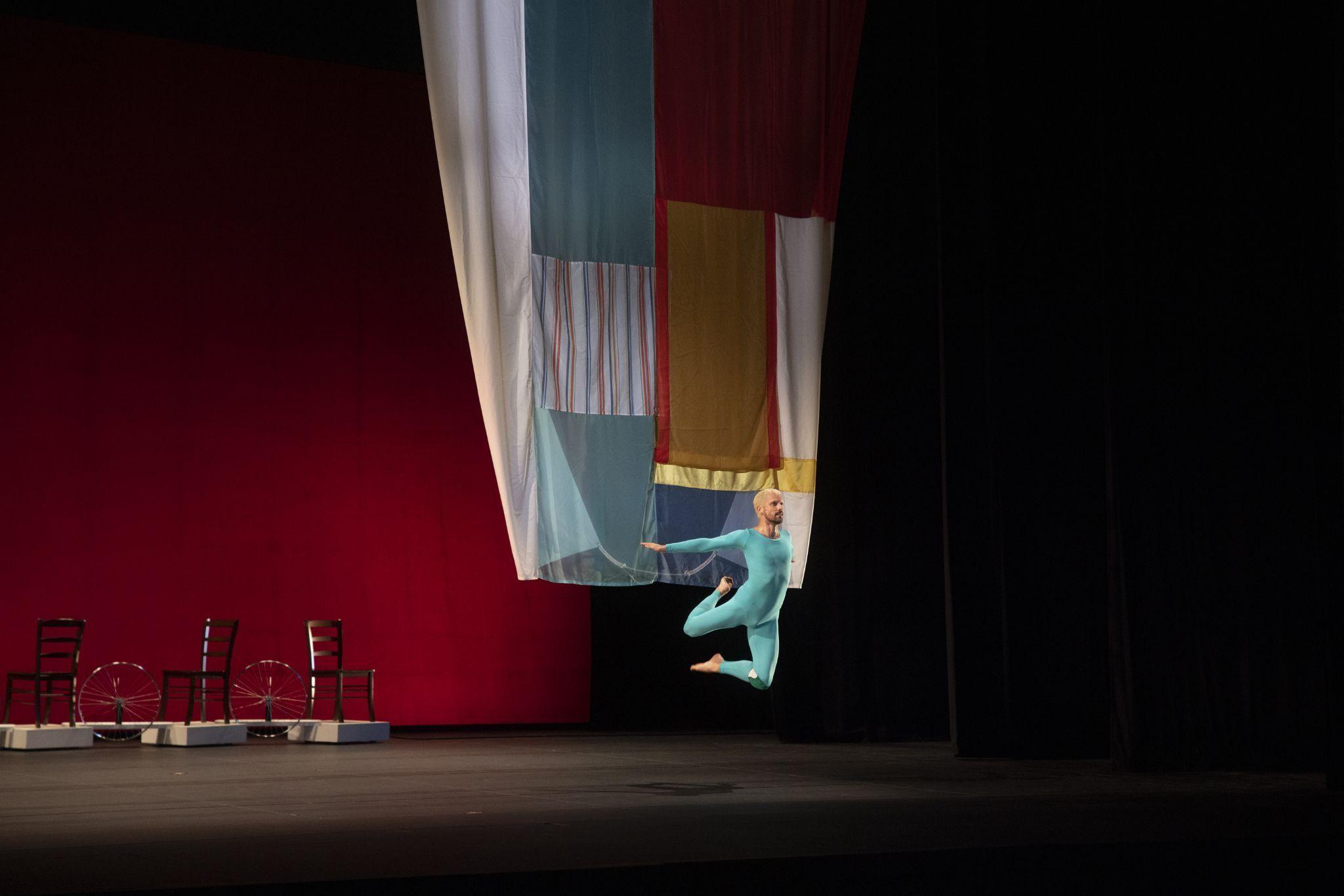
Visual liveliness was added by the use, throughout, in appropriate places and thus as an integral part of the production, not an add-on, of Eurhythmics, the particular form of movement / dance developed by Rudolf Steiner. The Eurhythmics-performers commented on the plot by their activity, or enhanced its impact, particularly for the scenes showing Mephisto’s nature and his machinations, and the scenes focusing on the wider world of evil, the witches’ kitchen and the Walpurgisnacht.
All of the production was guided by the Apollonian rather than a Dionysian approach. Overall, the production eschewed any tendency towards televisual realism, which in contemporary productions, especially of the classical repertory, necessitates the use of microphone amplification. The Goetheanum Faust did without amplification, relying on the actor’s vocal training to ensure every syllable was heard clearly all the way to the back row. The style of speaking Goethe’s verse was declamatory without any danger of turning either pathetic or in the least boring. Rather, it fitted the environment in terms of conceptual scope, and depth, and of the visual impact of the spiritual brutalism architecture.
The overall serious tone of the play and production was frequently enlivened by intentionally witty and deeply funny moments – fitting in with the plot organically rather than coming across as add-ons. In Part I, for example, Lieschen entered the scene riding a bicycle, and Wagner, Faust’s disciple, was funny in his overwhelming enthusiasm for knowledge just after we had witnessed Faust’s long tirade about his own frustration with knowledge. Wagner was even funnier because Faust did specifically not mock him, in the slightest, but took his enthusiasm seriously – and he seriously deplored it.
The performers involved in this production represented a wide range of experience and training backgrounds. Some had specialist training and varying degrees of practice in Eurhythmics. Balz Aliesch had composed the music and led the orchestra, on the gallery by the organ, at the back of the auditorium, high up under the ceiling. The orchestra consisted of piano, organ, two violins, viola, cello, double bass, guitar, clarinet, bass clarinet, and percussion instruments. The music itself was classical in style, with many brief, playful references to themes and chords reminiscent of Wagner. Some of the actors had spent many years exclusively in the Goethanum Faust context, for others their employment for this production was one of many freelance contracts over a typical season. Some actors were still training at a recognized acting school, others had decades of experience to their credit. It was a major achievement of director Andrea Pfaehler to mold those differences of ages, profiles, experience and training into the homogenous whole that we encountered in this production.
Torsten Blanke’s middle-aged Faust and old Faust, was the Faust of resignation and despair, dissatisfied with conventional knowledge, which he had explored in depth and in vain, and whatever Mephisto was able to offer him as alleged add-on to conventional knowledge. Blanke moved with ease and spoke with a particularly mellifluous voice. Jeroen Engelsman was the other Faust-actor, selected for the scenes that see Faust outwardly rejuvenated, during the interventions of Mephisto. Engelsman’s delivery was appropriately faster, full of enthusiasm, hope, and many other emotions, usually heightened, near-excessive, irrational, driven, in danger of losing control.
Katharina Schumacher was the female Mephisto, predominantly characterized by embodying the role of the devil as witty, sharp, cruel fool. She constantly challenged Faust, his conventions of life and of thinking, but also the circumstances in which Mephisto was expected to lead Faust to new and better experiences. Schumacher gave Mephisto a feline embodiment, crouching, clawing with legs, feet, arms, hands, fingers, spine, neck and teeth, spitting her sharp words like arrows, literally backbiting – physically a most strange, non-human, menacing, threatening, and both inherently and outwardly a most sinister, unpredictable dangerous and fearsome creature. She spoke her lines with pristine clarity, molding enunciation and modes of speaking in line with her feline nature to include snarling and spitting the words like a cat.
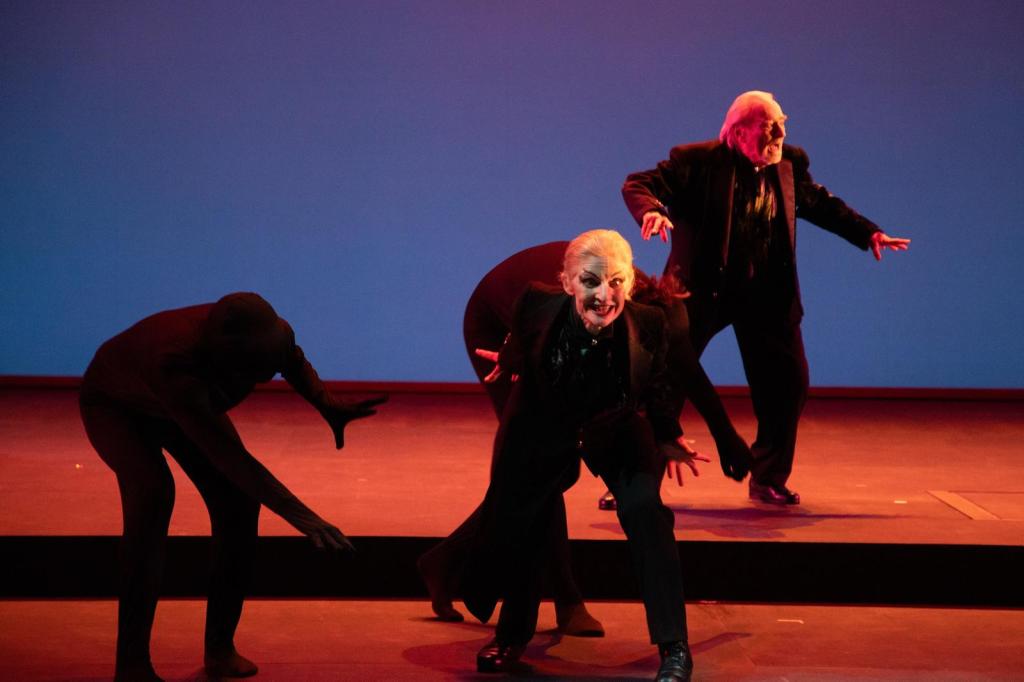
Katharina Schumacher and Urs Bihler as Mephisto. Photo credits: Laura Pfaehler.
In contrast, Jonas Gygax’s Mephisto was the suave charmer, the witty courtier, with fast-paced, clipped, educated, aristocratic speech and demeanor. Thomas Daviaud’s Mephisto was the melancholy fellow, prone to engage in thoughtful tirades about the sorry state of whatever affairs he was invited to comment on. He reminded me of Jacques in Shakespeare’s As You Like It. Urs Bihler was Mephisto as the old man who was at the same time ageless: aware of his powers, but also, unlike Mephisto’s other manifestations, aware of the limitations of that very power. He was a sad and angry old man, angry at the role as God’s servant even in exile from paradise, at his dependence on God’s every mood and whim, which might change any moment, and with it might change the rules he had expected to be working under. Above all, the endless mill of doing and being evil was making this old Mephisto ever so angry, at the system, at God, at himself and his other manifestations, and at those humans against whom he was meant to work his evil in the first place.
The eurythmic component of the production worked particularly well to evoke overall moods. Gentle moods were enhanced by the dancers wearing costumes with many layers of veils, and movement patterns that reminded me of South Asian Kathak or Bharata Natyam. The devilish moods were strikingly captured by more forceful movements, bordering on ferocious – I was reminded here of the intensity of Butoh. The performers of eurhythmics usually performed in smaller or larger groups. Ludger Heidrich as Euphorion, the son of Faust and Helena, was the exception from this principle, vividly embodying and expressing the nature of this character – on the cusp between childhood and boyhood (reminiscent of Björn Andresen as Tazio in Visconti’s film Death in Venice), with elements of both, including exuberance, abundant energy and stubbornness; a marked aerial quality represented Euphorion’s attraction to the element of air, expressed in his urge to fly, leading to his early death reminiscent of the Greek Icarus myth.
Sangita Singh played Gretchen. She rose well to the challenge of creating a meaningful balance of natural naivety, being bound by moral patterns of her time and society, breaking those boundaries and accepting and living with the consequences of her crimes. Gretchen’s strong, indefatigable belief in God goes well beyond the dogma of religion and represents the one unshakeable foundation of her life, which gives her the strength she needs to overcome initial stages of mental imbalance to rise to renounce Faust as the basis of her ultimate salvation. Anna Angelini’s Helena was aware of her beauty, and was happy and natural with and about it, not proud, vain, or presumptuous. She had become aware early on in her life that beauty and happiness in life do not go well together – this insight and resulting attitude allowed her to cope well with blows of fate, such as the death of Euphorion.
Another set of performances has been planned for 2027, with further work on the production most likely. In particular, Urs Bihler, once a member of Peter Brook’s company, including the famous Mahabharata in the 1980s, played Mephisto for one last time this year – for 2027, a new actor may be joining the team, or the lines allocated to him this year may be split among the remaining three actors of the role.
This post was written by the author in their personal capacity.The opinions expressed in this article are the author’s own and do not reflect the view of The Theatre Times, their staff or collaborators.