
![7th Sep: Mythical Kitchen (2026), 50 Episodes [TV-14] (6/10)](https://occ-0-487-92.1.nflxso.net/dnm/api/v6/0Qzqdxw-HG1AiOKLWWPsFOUDA2E/AAAABR9gw4vluRzgTijtH7cO6CCTvbwKcSnPQILc6RIuLXvWvWaiLvmyapjmdEFyj8CowQJc2Ubjsu6ge-msjfIQzBNev2T0FPY8H9zgkWgScSxoO3lxT2g3q_rncLAlrjyWzO3sOYt_g0YQgjvtYgE4OAUxJBgXrn4AfgP1ofRYKI7HxRqtK5-dlhhyaGnd8k5opCtosgyFft8UPz6Q3fyGVeQP37YZAqBRYkySc5kMQbwegz8f0tPoy2NkXrzVhklRnGz2rJwaxuE3Z-YmOYfY5wGYMFAaIGAOfdDIvIJo5J5N41jrl3GfjH3yhYOBmg.jpg?r=c39 "7th Sep: Mythical Kitchen (2026), 50 Episodes [TV-14] (6/10)")



The Shaw Festival Theatre Review: Adrienne Kennedy’s “Ohio State Murders” confronts the violence buried beneath memory, literature, and institutional power
By Ross
When Suzanne Alexander begins her lecture about her work and the violent images in her writing, there is a focused uncertainty embedded in her words that becomes part of the grip of the Shaw Festival’s Ohio State Murders. Sophia Walker gives Suzanne the composed authority of an acclaimed Black writer returning to Ohio State University, standing before us poised and determined in the Jackie Maxwell Studio Theatre. Yet something unfinished simmers underneath that composure, a tremor in the woman delivering the lecture that makes us lean in and take notice.
“I was asked to talk about the violent images in my stories,” she informs us, slipping details about “the murder” into the conversation as though we should already know the trauma waiting underneath. Directed astutely by Philip Akin (ShawFest’s The House That Will Not Stand), this 55-minute pseudo-memory play written by Adrienne Kennedy (He Brought Her Heart Back In A Box) assembles itself through fragments, literary references, gestures, and a past that refuses to settle into a straightforward chronology. Walker (CanStage’s Clyde’s) makes that uncertainty compelling and memorable. We are captivated by her Suzanne as she slowly begins to reclaim a story about her life at this university, the violence intertwined in her writing, and how it shaped her being.
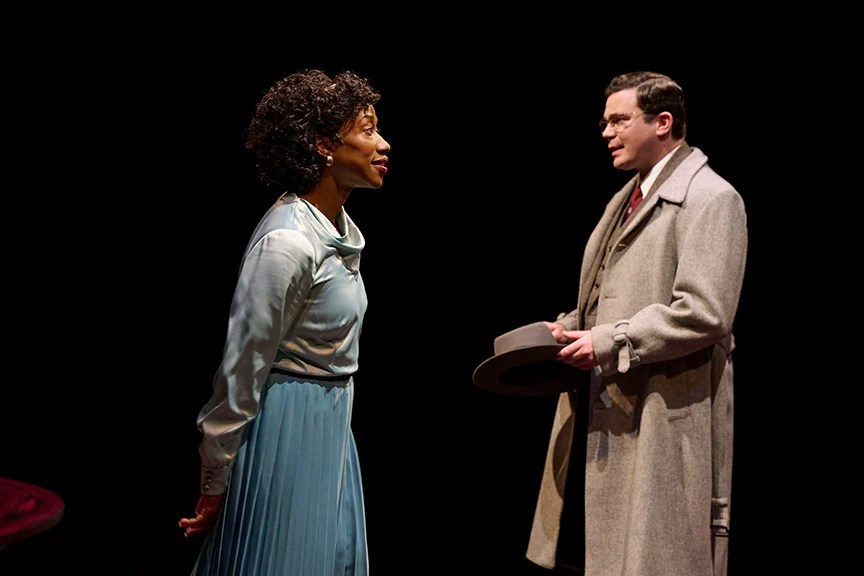
A tense, strange relationship between literature and lived experience emerges in Ohio State Murders as André Morin (ShawFest’s Tons of Money), as Robert Hampshire, Suzanne’s former English teacher, enters with an unnervingly stiff, stifled presence. His physicality is clear from the moment he begins reading from Thomas Hardy’s novel, Tess of the d’Urbervilles. We listen to the exquisite poetry while searching for the clue hidden inside it. Hardy’s novel carries its own history of women being judged according to standards created to protect a social order that had little interest in actually protecting them, and Kennedy uses that literary history as a bookmark into Suzanne’s story. The provocative subtitle of Hardy’s novel, A Pure Woman Faithfully Presented, becomes particularly pointed in a play concerned with a Black woman navigating an institution and a society determined to define what she can be. Morin gives Hampshire a restrained menace that never announces itself, while Walker listens, watches, and absorbs, making Suzanne’s attention feel like an act of survival rather than engagement. Their subtle connection has the quality of two people circling something neither can quite say aloud.
Akin’s direction embraces that quality wisely. The audience surrounds the performers on all sides, creating an intimate arrangement in which Walker seems to be speaking to everyone at once, and trying to make sure no corner of the room escapes the story. Someone near me described the style as ‘lighthouse acting’, and the astute description captures something about the constant rotation of the performers through the space. That rotating need also creates an occasional physical awkwardness, particularly when Walker has to navigate Melanie McNeill’s looping, racetrack-like set. Ramps, tabletops, and book bindings embedded into the scenery create a landscape where education and memory become physical obstacles. The steep road toward an education in English literature becomes a pointed metaphor for Suzanne’s experience as a Black woman entering a world where others, like Morin’s Hampshire, seem to move effortlessly. She has to climb, negotiate, and find her way up and around barriers that the institution has placed in her path, turning the set’s obstacles into something that affects the performers as much as the character.
That physical tension gives McNeill’s design an intriguing relationship with the story. Books are built into the pathways, making education something Suzanne can see before her, within reach, but must physically step over or move around. Jeff Pybus’s focused lighting establishes the enclosed atmosphere, although I wanted it to push further into the psychological claustrophobia of Suzanne’s memories and landscape. The production creates a world in which the past feels inescapably present, but the lighting sometimes remains too generalized to make that pressure fully visceral. Jacob Lin 林鴻恩’ s original music and sound provide another layer to the carefully constructed environment, helping the fragments of memory and literature move around us without overwhelming Kennedy’s text.
Walker is extraordinary at making Suzanne’s restraint feel active. Anger lives and burns within her performance, but it is anger that has been examined, stored, revisited, and carried for years. Early in the play, she mirrors Robert’s body language in a sharply defined moment of mimicry, and suddenly the distance between the remembered student and the man who taught her begins to collapse. That comical parody of his gait and posture is a small physical choice with enormous implications. Suzanne is not simply remembering what happened to her. She is reconstructing the people, language, structures, and the prejudice that surrounded her when life was stolen from her and destroyed. Walker lets us watch her put those pieces back together while never giving the audience the comfort of a clean emotional release.
King Arthur enters the story more than halfway through as another literary reference, but where Hardy’s Tess of the d’Urbervilles carries the weight of social judgment and the rules imposed upon women, the Arthurian legend offers the seductive construction of order from chaos. The stories of kings, knights, honour, betrayal and heroic sacrifice give violence a shape that can be easier to understand, and even easier to accept. Kennedy places that mythology alongside Suzanne’s fractured history, suggesting that literature can give us the language to make sense of terrible things. But it can also create the stories through which we decide whose violence is remembered as heroic and whose suffering is left behind
The clinical quality of Kennedy’s writing can create distance from the heartbreak, and at times I found myself wishing the production would allow the pain to sit still for a moment. Instead, Akin keeps the movement circulating, with Walker and Morin repeatedly shifting through the space as though searching for a way through a maze whose walls keep changing. There is an almost cruel precision to that choice. Suzanne is trying to navigate a past that refuses to become orderly, and the production refuses to make that navigation comfortable for any of us. The racism she encounters is not presented as a single act of cruelty but as something embedded in the institution she has entered, the expectations placed upon her, and the assumptions about who belongs there.

Ohio State Murders is a demanding 55 minutes, asking us to listen closely and assemble the pieces alongside Suzanne. I found myself wanting more time with her, particularly with the grief that sits beneath the intellectual precision of her storytelling. Yet the compressed runtime also suits a story that refuses to give us a complete, comfortable account of itself. Suzanne arrives carrying the evidence rather than offering a tidy explanation. Walker gives that act of looking extraordinary weight, while Morin’s tightly contained performance ensures that the tension never completely leaves the room.
When Suzanne returns to Ohio State, she is returning to the place where literature, education, racism, and violence became tangled together in her life. By the time Walker has finished taking us through those fragments, the terrible cost of carrying a history an institution would rather leave buried hangs heavy in the air. Kennedy’s Ohio State Murders does not allow Suzanne to simply close the book on what happened. She opens it, reads from it, tears through its pages, and then demands we sit with her words. In Walker’s hands, that act becomes its own form of resistance. She stands in the middle of this room surrounded by books, memories, and barriers, and keeps telling the story because the story is hers to tell.