



If you want to know how any new production of Samuel Beckett’s absurdist classic Waiting for Godot will approach the work, your first clue is set design. The play’s tree — an iconic set piece, a symbol for symbols — bears the weight of overdetermined meaning. As does, counterintuitively, the nothingness surrounding the tree.
For instance, the 1978 French En attendant Godot, directed by Otomar Krejča, featured an abstract scribble of a tree and a flat, circular stage. This past year in Toronto, Kelli Fox’s production at Coal Mine Theatre adopted a mix of gritty realism and meta-theatricality — gnarled tree, mounds of sand, conspicuously painted backdrop. Jamie Lloyd’s 2025 Broadway production forgoes the tree altogether, placing actors Keanu Reeves and Alex Winter in a futuristic wooden cylinder.
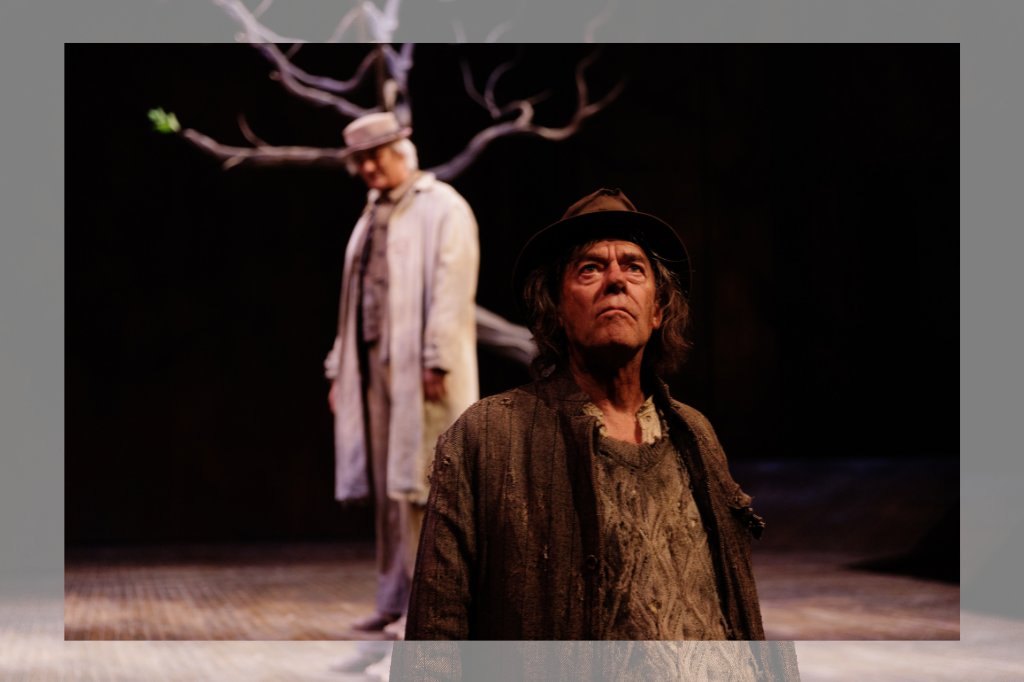
The Stratford Festival’s 2026 Waiting for Godot, directed by Molly Atkinson, looks familiar. In the Festival Theatre, a tree appears to grow through the stage floor. Broken floorboards jut against its trunk. Apart from this localized scene of destruction, the stage feels pedigreed and a little placid, cherry wood gleaming.
Sean Mathias’ high-profile London and New York productions of the play in 2009 and 2013 used a similar conceit. A tree pushing through a jagged hole — that time, on a dingy stage. To be clear, my point is not to indict set designer Cory Sincennes for echoing an effective choice. The tree is but a symptom of a larger malady: Atkinson’s Godot never feels fully its own.
This is a competent rendition of the play. Middle of the road, if you will — a pun on the play’s setting, where the characters Vladimir (a.k.a. Didi) and Estragon (Gogo) wait for a figure named Godot who never appears. Tom McCamus, who plays Estragon, is a celebrated actor in his 19th season at Stratford. Paul Gross is, likewise, a veteran of Canadian film and theatre. Their performances are clear and intentional. Nonetheless, I struggled to connect with this production.
I suspect a mismatch between staging and venue may be a factor. From orchestra seating, I often found the dialogue hard to hear, as if the theatre had absorbed the sound. The blocking doesn’t always work for the thrust stage, with action seeming to linger on a distant side, or bodies blocking one another from my sightline. I received the strange impression that the play was happening very far away from me, an effect that even larger theatres usually manage to avoid.
Perhaps because of this, the production leans more intellectual than physical, more tidy than unruly. Although the drama refers relentlessly to bodies under duress, and Sincennes’ costume design offers a requisite dusty dishevelment, physicality appears politely secondary to Beckett’s language. This is not necessarily a problem: the language work is good. Beckett’s jokes land, and what is inscrutable on the page becomes scrutable on the tongues of capable performers. And yet, ironically for a play with a loose grasp on the past or future, the production lacked presence.
At some points, this cold composure worked in the play’s favour. McCamus delivered Gogo’s repeated line “I’m leaving,” for instance, in hilarious deadpan, earning a laugh from the audience each time. Bored, rhythmic banter between Didi and Gogo as they lost their places, figurative and real, emphasized a desensitized search for meaning.
But when the few clowning sequences occurred — Gogo attempting and failing to put on his boots; Gogo and Didi switching hats; Gogo, Didi, and Pozzo (Jonathan Goad) attempting to silence Lucky (David W. Keeley) — these moments felt mismatched with the otherwise dignified, if weary, energy of the show. These forays into physical humour also seemed slow, careful, and performed just right, exemplifying my overall impression of the production as cautious.
Classic plays such as this one can carry an unfair burden to innovate. I do not believe each new production should upstage the last or offer a clever gimmick, stamping the work with fresh authorial vision. I only wish Stratford’s production had not seemingly sidestepped opportunities for discovery. It is unfortunate that this Waiting for Godot follows on the heels of Coal Mine’s. My experience may have been different had I not first seen that production, which offered minute choices that built upon the text at every turn, and infused the cast dynamic with a sense of play. I am thinking, for instance, of the pathos and humor evoked by the bizarre dance of Lucky (Simon Bracken). What a fantastic moment: the possibilities are endless. Why button this performance, as the Stratford production does, with a stereotypical impression of a ballerina’s pirouette? In the end, I suppose I wanted a production that matched Beckett’s weird.
To that point, I was most drawn in by the preshow music, recorded by Alessandro Juliani. Staticky Christian hymns woven into a web of glitchy techno effects woven into devotional music in other languages. Music that hinted at spiritual searching. Once the show started, I was left waiting for this highly specific, evocative approach to the material to return.
Waiting for Godot runs at Stratford’s Festival Theatre until July 31. More information is available here.
Intermission reviews are independent and unrelated to Intermission’s partnered content. Learn more about Intermission’s partnership model here.

WRITTEN BY
Ferron Delcy
Ferron Delcy is pursuing her PhD in early modern literature at the University of Toronto. In 2024, Ferron participated in the New Young Reviewers program facilitated by Toronto Fringe and Intermission. She is a big fan of ghost stories, fog machines, and weird metaphors.
LEARN MORE