




A bedazzled pink diary and fluffy fur pen create an immediately incongruous opening image within the Gothic set of Riot King’s production of The Moors, by American playwright Jen Silverman. This diary changes hands from author to author throughout Silverman’s take on Bronte-esque dark romance, the visual anachronism a physical manifestation of the script’s two primary layers: a pastiche swinging between the comic and creepy with flair, and an homage to the authors who championed the Gothic genre. The Moors uses a contemporary lens to reflect on why these stories, often written by women, continue to impact and inspire interpretations ranging from ‘80s pop-rock to the silver screen. It’s a deliciously feral, fierce, and funny love letter that Riot King brings to life with exquisite theatrical penmanship.
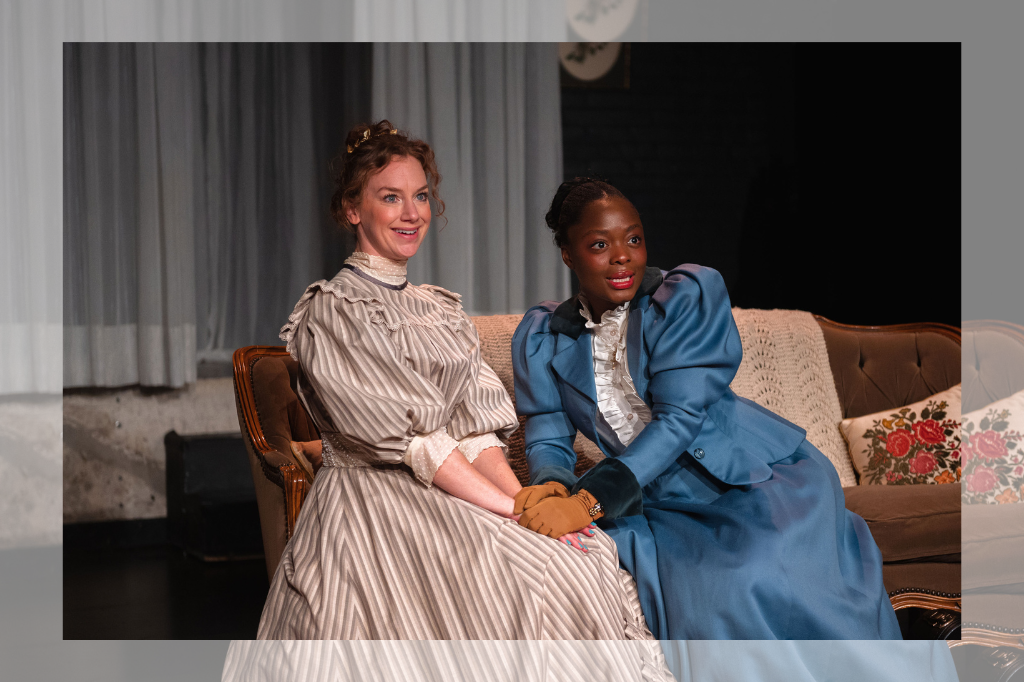
Something is instantly amiss when governess-for-hire Emilie (Blessing Adedijo) arrives at the highland estate of flirtatious pen pal Master Branwell — specifically, the absence of both Branwell and the child for whom she was hired to care. Instead, Emilie flings petticoat-first into the familial machinations of Branwell sisters Agatha (Raquel Duffy) and Huldey (Lindsey Middleton), who use her as a tool to one-up the other in their quest for passion and power. Agatha sees in Emilie an opportunity to cement domestic control over the manor, while Huldey needs a new character for her diary entries she hopes will bring her literary fame. Emilie, torn between the two, struggles to maintain her sense of self as the intrigue becomes increasingly all-consuming.
The story plays Gothic hits of isolated longing, simmering romance, and attic-based familial intrigue, but complicates these tropes with twists of queer yearning, comic self-awareness, and shocking bursts of violence that it frames as inevitable in a hostile landscape where women’s agency is finite. Time and space are a matter of opinion, with characters noting how each room of the “vast” manor looks identical, and that days of the week are defined by moods rather than hours; even the family Maid (Erin Humphry) passes herself off as multiple women at once, depending on the role she’s called to serve.
Silverman’s script and director/set designer Bryn Kennedy offer a vision of the Moors as a haunting purgatory, where embracing its harshness is essential to survival. Even Branwell’s Mastiff and a wandering Moor-Hen (Jack Copland and Heeyun Park 박희윤 respectively, both capturing an endearing animalistic innocence) find primal drives disrupting a tender connection, as they roam the marshes philosophizing about happiness in an initially hopeful counterpoint to the human drama.
Kennedy’s direction creates a delightfully tense and surreal rhythm that dials us into a tone of danger and mistrust. Every interaction between the ensemble seems intentionally off-tune. Humphrey’s Maid stands out in her often silent yet eye-catchingly active and ever-machinating background presence, stoically fighting to raise her rank. As too does Copland, plagued with doggy depression but reaching for a blissfully tragic hope that he can overcome his baser instincts through his avian friend.
Design elements infuse The Theatre Centre’s BMO Incubator with the atmosphere of a marsh-entrapped estate. Lighting and sound designers Franco Pang and Ian Ottis Goff offer a period-evoking foundation of warm, candle-like washes and string quartet underscoring, with dips into chilling, morgue-esque LEDs and drawn out rumbling frequencies that accentuate the play’s contemporary horror sensibilities. Characters gradually shed layers of Madeline Ius’ Victorian costumes — bustles, petticoats, and cravats — to reflect lowered guards, with brief glimpses of sheer plastic accessories adding anachronism.
The Moors’ greatest surprise amid its eerie excavation of Gothic Lit was, for me, its subtle tribute to female authors of the genre, like the Brontes. Whether Hudley is scribbling in that sparkly pink diary with manic dreams of renown, or bursting into a musical climax to her quest for stardorm (which Middleton performs with show-stopping pop-star aplomb), she offers an epic portrait of the power in the Bronte sisters’ pens. Silverman offers that even the uneasiest elements of Gothic romance were essential to the stories that allowed these authors a space to define their realities on their own terms, in a time where patriarchal structures systemically muted female voices.
Riot King’s programming seems presciently timed with the recent release of Emerald Fennell’s film version of Wuthering Heights, that painted coerced spousal submission as sexy. This play and production are not afraid to acknowledge, in surreal extremes, the uglier tolls of the isolating and harsh conditions that the women behind Gothic fiction endured. It’s a pastiche that, even at its goriest, offers visions of female empowerment, reclaiming the rawness of their narratives amid the wily, windy Moors.
The Moors runs at The Theatre Centre until April 19. More information is available here.
Intermission reviews are independent and unrelated to Intermission’s partnered content. Learn more about Intermission’s partnership model here.

WRITTEN BY
jonnie lombard
jonnie is a trans theatre artist / thing from the woods stumbling through sidequests of sentience. They were a participant in the 2024 New Young Reviewers Program, and will always say yes if you ask them to go dancing.
LEARN MORE